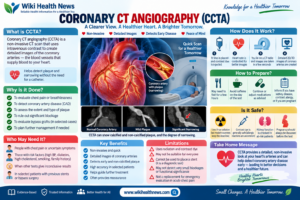
Coronary CT Angiography
Below is a patient-friendly, SEO-oriented article with 30 FAQs, anchor-text links, references, and an author card. The medical content reflects current CCTA guidance and patient information from ESC, AHA, and RadiologyInfo. (Radiologyinfo.org)
Coronary CT Angiography (CCTA): A Complete Patient Guide
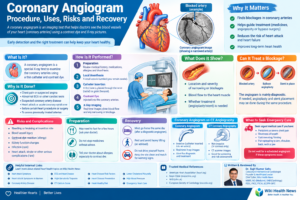
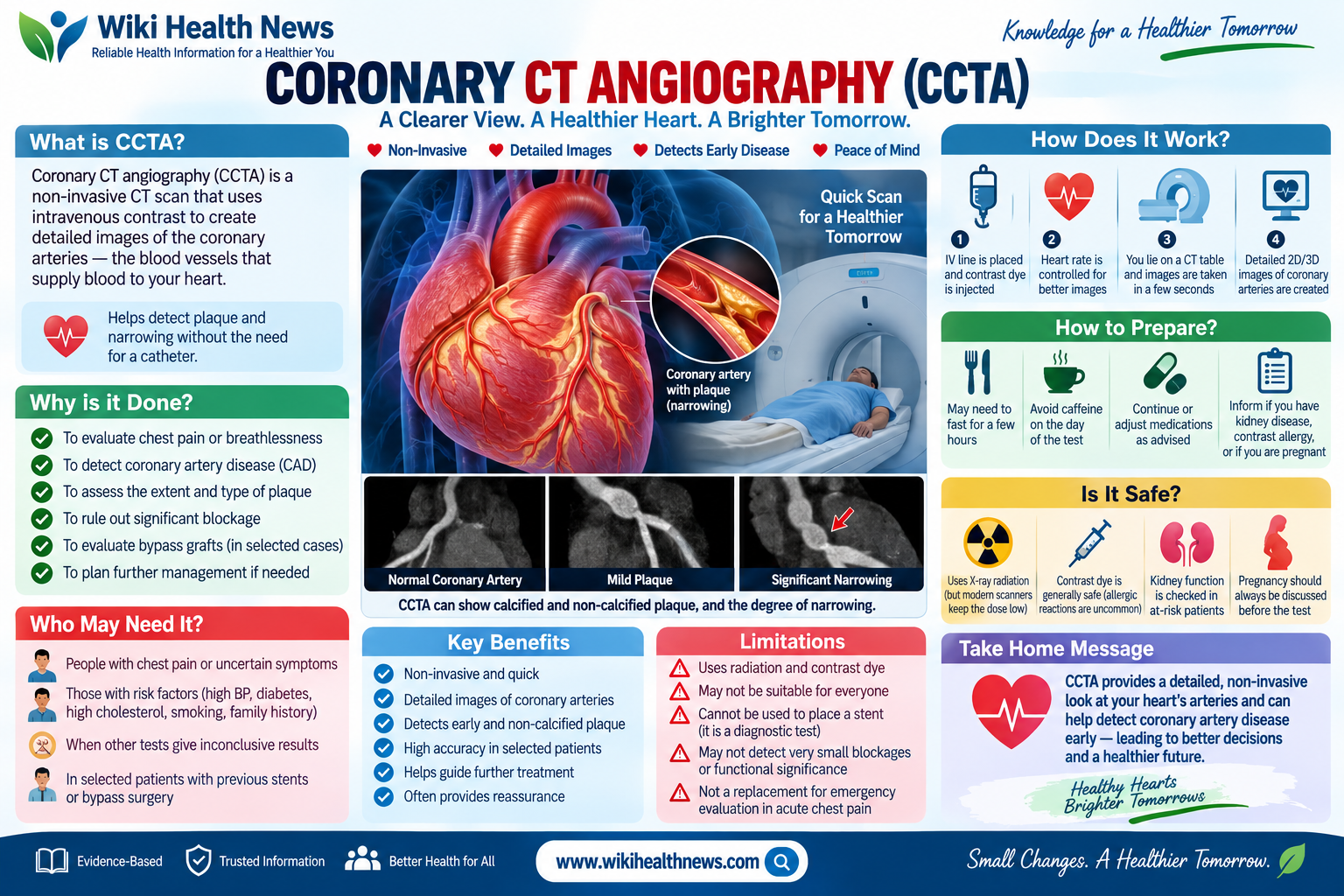
Coronary CT angiography (CCTA) is a non-invasive heart imaging test used to examine the coronary arteries—the blood vessels that supply oxygen-rich blood to the heart muscle. It uses a CT scanner and an intravenous iodine-containing contrast agent to create detailed, often three-dimensional images of the coronary arteries.
CCTA can identify coronary artery plaque, narrowing (stenosis), and coronary artery disease (CAD) without inserting a catheter into an artery. Modern guidelines consider CCTA an important first-line anatomical test for appropriately selected patients with suspected chronic coronary syndrome, particularly when the clinical likelihood of obstructive CAD is not very high. (American College of Cardiology)
Why is Coronary CT Angiography Done?
Your doctor may recommend CCTA when you have chest discomfort, unexplained breathlessness, cardiovascular risk factors, or an uncertain result from another cardiac test. It can help determine whether symptoms may be related to coronary artery disease.
CCTA can show both calcified and non-calcified plaque, the location of coronary narrowing, and the overall extent of atherosclerosis. It may also be useful for evaluating bypass grafts and selected coronary anatomical abnormalities. (Radiologyinfo.org)
For patients with stable symptoms, CCTA is particularly useful when the aim is to exclude obstructive CAD and identify non-obstructive coronary disease. The 2024 European Society of Cardiology guidelines place CCTA prominently in the diagnostic pathway for chronic coronary syndromes. (Escardio)
How Does the Test Work?
Before scanning, your heart rate and blood pressure are usually checked. A slower, regular heart rate improves image quality. Some patients may receive a beta-blocker or another medication to slow the heart rate if appropriate.
An intravenous line is placed, usually in the arm. Iodine-containing contrast is injected during the scan so that the coronary arteries become clearly visible. You will lie on a CT table while the scanner obtains images synchronized with your heartbeat.
You will usually be asked to hold your breath briefly while images are acquired. The scan itself is generally quick, although preparation may take longer than the actual imaging. (Radiologyinfo.org)
How Should You Prepare?
Preparation varies between imaging centers. You may be asked not to eat or drink for several hours and to avoid caffeine before the examination. Certain medications may need to be adjusted, particularly medications that affect heart rate.
Tell the medical team if you:
- Have kidney disease
- Have previously reacted to iodinated contrast
- Could be pregnant
- Are taking medications for erectile dysfunction
- Have an abnormal heart rhythm
- Have had previous coronary stents or bypass surgery
Never stop prescribed medication unless your healthcare team specifically instructs you to do so. (Radiologyinfo.org)
Is Coronary CT Angiography Safe?
CCTA is generally considered safe when appropriately indicated. However, it involves X-ray radiation and usually requires iodinated contrast.
The radiation dose varies according to the scanner, protocol, body size, heart rate, and other technical factors. Modern CT systems can substantially reduce radiation exposure.
Contrast reactions are uncommon, but allergic-type reactions can occur. Kidney function should be considered in patients with significant kidney disease. Pregnancy should always be discussed before a CT examination because radiation exposure needs special consideration. (Radiologyinfo.org)
What Does the Result Mean?
A CCTA report may describe the coronary arteries as normal, showing minimal or mild plaque, or showing moderate or severe narrowing.
Importantly, the percentage of narrowing does not always tell us whether a blockage is actually reducing blood flow to the heart. A moderate anatomical stenosis may not cause significant ischemia. Depending on the findings and symptoms, your doctor may recommend functional testing, CT-derived fractional flow reserve where available, or invasive coronary angiography. (DOI)
A normal or near-normal CCTA can provide strong reassurance that significant obstructive coronary disease is unlikely. However, symptoms can sometimes arise from microvascular disease or coronary vasospasm, conditions that may require additional evaluation.
CCTA vs Conventional Coronary Angiography
CCTA is non-invasive because it does not require a catheter to be advanced into the coronary arteries. Conventional coronary angiography, by contrast, involves cardiac catheterization.
A major advantage of invasive angiography is that it can be combined with treatment. If a significant blockage is identified during invasive angiography, procedures such as angioplasty and stent placement may be performed when appropriate. CCTA is diagnostic—it cannot place a stent or directly treat a blockage. (Radiologyinfo.org)
Final Takeaway
Coronary CT angiography has become an important tool for diagnosing and characterizing coronary artery disease. It can provide detailed information about plaque and coronary narrowing without invasive catheterization.
However, CCTA is not automatically the best test for every patient. Your symptoms, age, cardiovascular risk factors, kidney function, heart rhythm, previous coronary procedures, and the likelihood of CAD all influence test selection.
For more patient-friendly cardiovascular information, explore Wiki Health News heart-health resources and discuss your individual CCTA result with your cardiologist.
Medical disclaimer: This article is for general education and does not replace medical evaluation or individualized advice from a qualified healthcare professional.
30 Frequently Asked Questions About Coronary CT Angiography
1. What is coronary CT angiography?
Coronary CT angiography is a non-invasive CT scan that uses intravenous contrast to visualize the coronary arteries.
2. What is CCTA used for?
It is primarily used to evaluate suspected coronary artery disease and identify coronary plaque or narrowing.
3. Is CCTA the same as a CT scan?
CCTA is a specialized form of CT designed specifically to image the coronary arteries and heart.
4. Is contrast dye used in CCTA?
Yes. Most coronary CTA examinations use an iodine-containing intravenous contrast agent.
5. Is CCTA painful?
The scan itself is generally painless. You may feel a brief warm sensation when contrast is injected.
6. How long does coronary CT angiography take?
The actual scan is usually very short, although preparation and heart-rate control may require additional time.
7. Do I need to fast before CCTA?
Many centers ask patients to avoid food and drinks for a specified period before the examination. Follow the instructions provided by your imaging center.
8. Can I drink water before CCTA?
Instructions vary. In many situations, small amounts of water may be permitted, but follow your center’s specific instructions.
9. Can I drink coffee before CCTA?
You may be asked to avoid caffeine because heart-rate control can be important for image quality. (Radiologyinfo.org)
10. Why is my heart rate checked before CCTA?
A slower, regular heart rate generally produces clearer coronary images and reduces motion-related artifacts. (DOI)
11. Will I receive a beta-blocker?
Some patients receive a beta-blocker or another heart-rate-lowering medication if medically appropriate.
12. Can CCTA detect coronary blockage?
Yes. CCTA can identify coronary plaque and areas of narrowing or obstruction.
13. Can CCTA detect early coronary artery disease?
Yes. It can identify atherosclerotic plaque even when narrowing is not severe.
14. Can CCTA detect non-calcified plaque?
Yes. Modern CCTA can visualize both calcified and non-calcified coronary plaque. (Radiologyinfo.org)
15. Does a normal CCTA rule out a heart attack?
No. Someone with acute severe chest pain requires urgent medical assessment. CCTA is not a substitute for emergency evaluation of a suspected heart attack.
16. Can CCTA detect a 50% blockage?
CCTA can identify and estimate the severity of a coronary stenosis, but the anatomical percentage does not necessarily indicate whether the lesion causes ischemia.
17. Is a 50% blockage dangerous?
Not necessarily. Its importance depends on location, plaque characteristics, symptoms, overall coronary disease burden, and whether it limits blood flow.
18. What happens if CCTA shows severe blockage?
Your cardiologist may recommend further functional assessment or invasive coronary angiography, depending on symptoms and the overall clinical situation. (DOI)
19. Can CCTA replace coronary angiography?
In selected patients it can provide an alternative diagnostic approach, but it does not replace invasive angiography in every situation.
20. Can a stent be placed during CCTA?
No. CCTA is diagnostic. Stenting requires an invasive catheter-based procedure.
21. Is CCTA safe for the kidneys?
Most patients tolerate iodinated contrast well, but kidney function should be considered, particularly in patients with significant kidney disease. (www.heart.org)
22. Can I have CCTA if I have a contrast allergy?
Possibly, depending on the nature and severity of the previous reaction. Tell your healthcare team about any previous contrast reaction before the examination.
23. Can pregnant female undergo CCTA?
Pregnancy should always be disclosed before CT. If the examination is not urgent, alternative approaches or postponement may be considered. (www.heart.org)
24. Does CCTA involve radiation?
Yes. CCTA uses X-rays, although modern scanners and protocols can reduce radiation exposure. (Radiologyinfo.org)
25. Can CCTA show heart muscle damage?
Cardiac CT can provide information about certain structural abnormalities and previous myocardial damage, although other tests may be better suited for assessing myocardial viability or scar.
26. Can CCTA detect bypass graft problems?
Yes. CCTA can be used in selected patients to evaluate coronary artery bypass grafts. (Radiologyinfo.org)
27. Is CCTA useful after an abnormal stress test?
It may be useful in selected circumstances, but the choice between anatomical and functional testing depends on the clinical situation and the previous test result.
28. What if CCTA shows no major blockage but I still have chest pain?
Chest pain can occur despite non-obstructive coronary arteries. Microvascular dysfunction, coronary vasospasm, gastrointestinal disease, musculoskeletal problems and other causes may need consideration.
29. Can CCTA show calcium in the coronary arteries?
Yes. CCTA can demonstrate calcified plaque as well as non-calcified plaque.
30. Who should decide whether I need CCTA?
The decision should be made by your treating clinician or cardiologist after considering your symptoms, risk factors, examination, previous investigations and the suitability of CCTA for you.
Author Card
Dr. Sujit Kumar Sahu
Consultant Interventional Cardiologist
MBBS, MD (General Medicine), DNB (Cardiology), FSCAI, FESC, ICCPR-CRFC, FACC
Dr. Sujit Kumar Sahu is a Consultant Interventional Cardiologist with expertise in cardiovascular disease, coronary interventions and patient-focused cardiac care. His educational content is intended to help patients better understand cardiovascular conditions, investigations and treatment options.
Reviewed for patient education: Coronary CT Angiography / CCTA
Content type: Patient Education
Website: Wiki Health News
References & Further Reading
- European Society of Cardiology – 2024 Guidelines for Chronic Coronary Syndromes. The guideline places CCTA prominently in the diagnostic assessment of suspected chronic coronary syndromes. (Escardio)
- American Heart Association – Cardiac Computed Tomography Angiography. Patient information covering indications, procedure, radiation, contrast and safety considerations. (www.heart.org)
- RadiologyInfo – Coronary CTA. Detailed patient information regarding preparation, contrast, benefits, limitations and potential risks. (Radiologyinfo.org)
- NICE – Chest Pain and CT Coronary Angiography. Guidance on the role of CT coronary angiography in assessment of suspected stable angina. (Nice)
Internal resource: [Wiki Health News – Heart Health Information]
External patient resource: [American Heart Association – Cardiac CT Angiography]
External imaging resource: [RadiologyInfo – Coronary CTA]
For publication, I would use “Coronary CT Angiography (CCTA): Preparation, Procedure, Risks, Results & 30 FAQs” as the SEO title and add the article to your Cardiology / Heart Health category. The 2024 ESC guideline specifically supports CCTA as an important anatomical imaging option for suspected chronic coronary syndromes. (American College of Cardiology)