Coronary Angiogram: Procedure, Uses, Risks and Recovery
Coronary Angiogram: What It Is, Why It Is Done, Procedure, Risks and Recovery
What Is a Coronary Angiogram?
What Is a Coronary Angiogram?
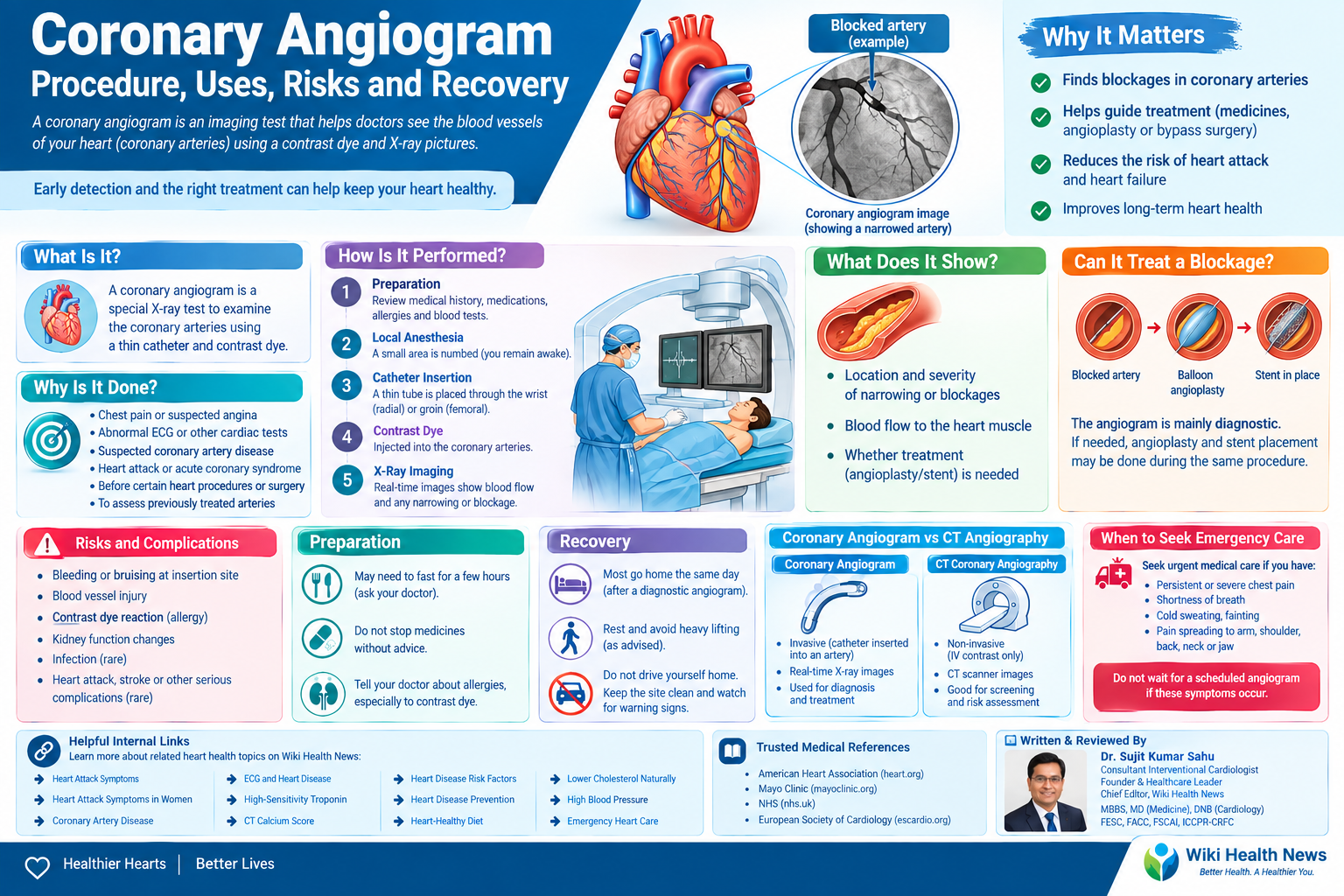
A coronary angiogram, also called coronary angiography, is a specialized X-ray test used to examine the blood vessels that supply the heart muscle. These blood vessels are called the coronary arteries.
During the procedure, a cardiologist inserts a thin flexible tube called a catheter into an artery, usually through the wrist or groin, and carefully guides it toward the heart. A special contrast dye is then injected through the catheter while X-ray images are taken. The contrast makes the coronary arteries visible, allowing the doctor to identify areas of narrowing or blockage.
A coronary angiogram is commonly performed when doctors need detailed information about the coronary arteries, particularly when coronary artery disease (CAD), angina, or a heart attack is suspected. It can also help doctors plan treatments such as angioplasty and stenting (PCI) or coronary artery bypass surgery (CABG) when significant coronary artery narrowing or blockage is identified.
If you want to understand the symptoms that may lead to an evaluation of the coronary arteries, read our guide on Heart Attack Symptoms. You can also learn more about Coronary Artery Disease and the Signs of Blocked Arteries in the Heart.
A coronary angiogram is an invasive test and is generally performed in a cardiac catheterization laboratory. Patients are usually awake, with local anesthesia used at the catheter insertion site. Some people may receive medication to help them relax.
What Can a Coronary Angiogram Show?
A coronary angiogram can help identify:
- Narrowing of a coronary artery
- Partial or complete coronary artery blockage
- The location and extent of coronary artery disease
- The coronary anatomy before certain heart procedures
- Whether treatment such as PCI or bypass surgery may need to be considered
When the severity of a narrowing is uncertain, doctors may use additional techniques such as fractional flow reserve (FFR) or intravascular imaging to obtain more information about the artery.
A coronary angiogram is different from a CT coronary angiogram (CCTA). CCTA uses a CT scanner to create images of the coronary arteries without placing a catheter into the coronary arteries, whereas conventional coronary angiography involves catheterization and contrast injection directly into the coronary arteries.
For patients who are undergoing evaluation for cardiovascular disease, related educational topics include Heart Disease Risk Factors, Heart Disease Prevention, CT Calcium Score, and High-Sensitivity Troponin.
Why Is a Coronary Angiogram Done?
Your doctor may recommend coronary angiography for several reasons, including:
- Chest pain or suspected angina
- Abnormal results on an ECG or other cardiac tests
- Suspected coronary artery disease
- A heart attack or acute coronary syndrome
- Significant narrowing detected on CT coronary angiography
- Evaluation before certain heart procedures or surgery
- Assessment of previously treated coronary arteries
- Planning for angioplasty or stent placement
A coronary angiogram may also be performed urgently during a heart attack when doctors need to identify the blocked artery and determine whether immediate treatment such as angioplasty and stenting is appropriate.
If you are experiencing possible symptoms of a heart attack, such as pressure or pain in the chest, shortness of breath, sweating, nausea or unexplained discomfort in the arm, jaw or back, seek emergency medical care rather than waiting for a scheduled test.
How Is a Coronary Angiogram Performed?
Coronary angiography is usually performed in a cardiac catheterization laboratory (cath lab).
1. Preparation
Before the procedure, your medical team will review your medical history, medications, allergies and relevant blood tests. Tell your doctor if you have previously experienced a reaction to contrast dye or have kidney problems.
You may be asked to avoid eating or drinking for a period before the procedure, depending on your circumstances and the hospital’s instructions.
2. Local Anesthesia
The procedure is generally performed using local anesthesia. You remain awake, although medication may sometimes be given to help you relax.
3. Catheter Insertion
A small tube called a sheath is placed into an artery, most commonly through the wrist (radial artery) or sometimes the groin (femoral artery).
A thin catheter is then carefully guided through the blood vessels toward the heart.
4. Contrast Dye Injection
The cardiologist injects contrast dye through the catheter into the coronary arteries.
The dye allows the coronary arteries to be seen clearly on X-ray images.
Some patients briefly experience a warm or flushing sensation when the contrast is injected. This usually passes quickly.
5. X-Ray Imaging
The cardiologist takes several X-ray images from different angles. These images help identify:
- Narrowed coronary arteries
- Complete blockages
- The location and severity of disease
- Blood flow through the coronary circulation
If a significant blockage is identified, treatment options can be discussed.
Can a Coronary Angiogram Treat a Blockage?
A coronary angiogram itself is primarily a diagnostic procedure.
However, if appropriate, coronary angiography can be followed by an interventional procedure such as percutaneous coronary intervention (PCI).
During PCI, a balloon may be used to widen a narrowed artery, and a coronary stent may be placed to help keep the artery open.
The decision to perform PCI depends on the patient’s symptoms, clinical condition, angiographic findings and other factors.
How Long Does a Coronary Angiogram Take?
A straightforward diagnostic coronary angiogram may take approximately 20–30 minutes, although the total time spent in the hospital is longer because preparation and recovery are also required.
If additional procedures such as angioplasty or stent placement are necessary, the procedure can take longer.
Is a Coronary Angiogram Painful?
Most people do not experience significant pain.
You may feel:
- A brief sting when local anesthesia is administered
- Pressure when the catheter is inserted
- A warm sensation when contrast dye is injected
- Mild discomfort at the catheter insertion site
Tell your medical team if you experience significant pain or discomfort during the procedure.
What Are the Risks of Coronary Angiography?
Coronary angiography is generally considered a safe procedure, but like any invasive medical procedure, it has potential risks.
Possible complications include:
- Bruising or bleeding at the catheter insertion site
- Swelling or hematoma
- Infection
- Temporary abnormal heart rhythm
- Blood-vessel injury
- Allergic or other reactions to contrast dye
- Kidney injury related to contrast in susceptible patients
- Blood clots
- Heart attack
- Stroke
- Very rarely, serious or life-threatening complications
The individual risk depends on factors such as age, kidney function, overall health, the reason for the procedure and whether an intervention is also performed.
What Happens After a Coronary Angiogram?
After the procedure, you will usually be monitored for a period of time.
If the catheter was inserted through the wrist, you may have a compression device placed over the access site. If the groin was used, you may need to lie flat for some time.
Your doctor will discuss the angiogram findings with you and explain whether further treatment is required.
Depending on your condition and the type of procedure performed, some patients can go home the same day, while others may need to stay in the hospital.
Recovery After Coronary Angiography
Recovery after a diagnostic angiogram is usually relatively quick.
Your doctor may advise you to:
- Drink fluids if appropriate to help eliminate contrast dye
- Keep the catheter-entry site clean and dry
- Avoid strenuous activity for the recommended period
- Follow medication instructions carefully
- Watch for increasing swelling, bleeding or pain at the access site
If you develop significant bleeding, severe chest pain, severe shortness of breath, weakness, difficulty speaking or other concerning symptoms after the procedure, seek urgent medical attention.
What Does a Coronary Angiogram Show?
The angiogram provides detailed information about the coronary arteries, including the location and extent of narrowing or blockage.
Your cardiologist may describe arteries as having mild, moderate or severe narrowing. In some cases, additional tests may be required to determine whether a particular narrowing is actually limiting blood flow and whether treatment is beneficial.
Treatment may involve:
- Lifestyle changes
- Medications
- Continued observation
- PCI with balloon angioplasty and stenting
- Coronary artery bypass surgery (CABG)
The appropriate treatment depends on the overall clinical picture rather than the angiogram alone.
Coronary Angiogram vs CT Coronary Angiography
A conventional coronary angiogram uses a catheter inserted into an artery and is an invasive test.
CT coronary angiography (CTCA) uses a CT scanner and intravenous contrast to produce images of the coronary arteries without placing a catheter into the coronary arteries.
Both tests have different indications. Your doctor will recommend the most appropriate test based on your symptoms, risk factors and clinical situation.
Frequently Asked Questions
Is coronary angiography the same as a coronary angiogram?
The terms are commonly used interchangeably. Coronary angiography refers to the imaging procedure, while a coronary angiogram can refer to the resulting images or the procedure itself.
Is a coronary angiogram a major procedure?
It is an invasive cardiac procedure, but a diagnostic angiogram is generally performed through a small arterial access site and is usually completed relatively quickly.
Can I eat before a coronary angiogram?
Your hospital will provide specific instructions. Some patients are asked to fast before the procedure.
Can I take my regular medicines?
Do not stop medications on your own. Your cardiologist will tell you which medications should be continued or temporarily withheld.
Is contrast dye used?
Yes. A contrast agent is injected through the catheter to make the coronary arteries visible on X-ray.
Can coronary angiography detect blocked arteries?
Yes. It can show narrowing and blockage within the coronary arteries.
Does every blockage require a stent?
No. The decision depends on symptoms, the severity and location of disease, blood-flow significance, clinical circumstances and other factors.
Can a coronary angiogram cause kidney problems?
Contrast exposure can sometimes affect kidney function, particularly in people who already have kidney disease or other risk factors. Your medical team assesses the risk before the procedure.
How soon can I return to normal activities?
Recovery varies according to the access site, your overall health and whether an additional procedure such as PCI was performed. Follow your cardiologist’s instructions.
Coronary Angiogram: 30 Frequently Asked Questions
1. What is a coronary angiogram?
A coronary angiogram is an imaging test used to examine the coronary arteries that supply blood to the heart muscle. A contrast dye is injected through a catheter, and X-ray images are taken to identify narrowing or blockages.
2. Why is a coronary angiogram performed?
It may be recommended when coronary artery disease is suspected, when there are concerning symptoms such as chest pain, after certain abnormal cardiac tests, or during a heart attack to identify a blocked coronary artery.
3. Is a coronary angiogram the same as coronary angiography?
The terms are commonly used interchangeably. Coronary angiography describes the imaging procedure, while a coronary angiogram may refer to the procedure or the resulting images.
4. How is a coronary angiogram performed?
A thin catheter is inserted into an artery, usually through the wrist or sometimes the groin. It is guided toward the heart, contrast dye is injected, and X-ray images are obtained.
5. Is coronary angiography painful?
Most people experience little pain. There may be a brief sting from the local anesthetic, pressure at the access site, or a short-lived warm sensation when contrast dye is injected.
6. Where is the catheter inserted during a coronary angiogram?
The catheter is commonly introduced through the radial artery in the wrist. In some situations, the femoral artery in the groin may be used.
7. How long does a coronary angiogram take?
A diagnostic coronary angiogram may take around 20–30 minutes, although the total hospital visit can be several hours because preparation and recovery are also required.
8. Are patients awake during coronary angiography?
Yes. Most coronary angiograms are performed under local anesthesia while the patient remains awake. Medication may sometimes be given to help the patient relax.
9. What contrast dye is used during a coronary angiogram?
An iodine-containing contrast agent is commonly used to make the coronary arteries visible on X-ray images.
10. Will I feel the contrast dye?
Some people briefly experience warmth, flushing or a mild unusual sensation when the contrast is injected. It generally passes quickly.
11. Can a coronary angiogram detect blocked arteries?
Yes. Coronary angiography can show the location and severity of narrowing or complete blockage in the coronary arteries.
12. Does every coronary blockage require a stent?
No. A blockage does not automatically mean that a stent is required. Treatment depends on symptoms, the location and severity of disease, blood-flow significance and the patient’s overall clinical condition.
13. Can angioplasty be performed during a coronary angiogram?
If a significant blockage is identified and PCI is appropriate, angioplasty and stent placement may sometimes be performed during the same procedure.
14. What is the difference between an angiogram and angioplasty?
An angiogram is primarily a diagnostic imaging procedure used to visualize blood vessels. Angioplasty is a treatment procedure used to open a narrowed or blocked coronary artery, often with placement of a stent.
15. Is coronary angiography safe?
Coronary angiography is generally considered safe, but it is an invasive procedure and can have complications such as bleeding, blood-vessel injury, contrast reactions and, rarely, more serious complications.
16. What are the common side effects of a coronary angiogram?
Minor bruising, tenderness or a small swelling at the catheter insertion site can occur. Temporary warmth from the contrast dye is also common.
17. Can a coronary angiogram damage the kidneys?
Contrast dye can sometimes affect kidney function, particularly in people with pre-existing kidney disease or other risk factors. Doctors may assess kidney function before the procedure and take precautions when necessary.
18. Can someone be allergic to the contrast dye?
Reactions to contrast agents can occur. Tell your doctor if you have previously experienced a reaction to contrast dye or have significant allergies.
19. Do I need to fast before a coronary angiogram?
You may be asked to avoid food or drink for a specified period before the procedure. Follow the exact instructions provided by your hospital or cardiologist.
20. Should I stop my medicines before a coronary angiogram?
Do not stop medications without medical advice. Your cardiologist will tell you whether any medicines need to be adjusted before the procedure.
21. Can I take my blood pressure medicines before an angiogram?
Some medications may be continued, while others may need adjustment depending on your health and the procedure. Follow your cardiologist’s specific instructions.
22. How long do I need to stay in the hospital after an angiogram?
Some patients undergoing uncomplicated diagnostic angiography can go home the same day. Others may require observation or hospitalization depending on their medical condition and whether additional treatment is performed.
23. How long does it take to recover from a coronary angiogram?
Recovery after an uncomplicated diagnostic angiogram is usually relatively quick. However, the recommended activity restrictions depend on the catheter access site and whether angioplasty or another procedure was performed.
24. Can I walk after a coronary angiogram?
Walking is often possible after an uncomplicated radial-access procedure once the medical team considers it safe. After femoral access, you may need to remain lying down for a period of time.
25. Can I drive home after a coronary angiogram?
Patients are generally advised not to drive themselves immediately after the procedure. Arrange transportation according to your hospital’s instructions.
26. What should I watch for after a coronary angiogram?
Watch for persistent or increasing bleeding, significant swelling, severe pain, changes in limb color or sensation, fever, chest pain or shortness of breath. Seek medical attention if concerning symptoms occur.
27. What happens if a major blockage is found?
Depending on the findings and your clinical condition, treatment may include medications, PCI with angioplasty and stenting, or referral for coronary artery bypass surgery.
28. What is the difference between a coronary angiogram and CT coronary angiography?
A conventional coronary angiogram uses a catheter inserted into an artery and is invasive. CT coronary angiography uses a CT scanner and intravenous contrast to create images of the coronary arteries without placing a catheter inside the coronary arteries.
29. Can a coronary angiogram show all heart problems?
No. Coronary angiography primarily evaluates the coronary arteries. Other tests such as echocardiography, ECG, cardiac MRI or blood tests may be needed to assess other aspects of heart health.
30. When should I seek emergency care instead of waiting for an angiogram?
Seek emergency medical care for symptoms suggestive of a heart attack, such as persistent or severe chest pressure or pain, shortness of breath, cold sweating, fainting, or unexplained pain spreading to the arm, shoulder, back, neck or jaw. Do not wait for a scheduled angiogram if these symptoms occur.
Key Takeaway
A coronary angiogram is an important test for examining the coronary arteries and identifying narrowing or blockages. It can help doctors determine the cause of symptoms, assess coronary artery disease and plan appropriate treatment.
Although coronary angiography is generally safe, it is an invasive procedure and has potential risks. Your cardiologist can explain the expected benefits and risks based on your individual medical situation.
Medical Disclaimer
This article is intended for general patient education and does not replace professional medical advice. If you have chest pain, severe breathlessness, fainting, sweating or other symptoms that could indicate a heart attack, seek emergency medical care immediately.
Medically Reviewed / Written By
Dr. Sujit Kumar Sahu
Consultant Interventional Cardiologist | Founder & Healthcare Leader | Chief Editor, Wiki Health News
Qualifications: MBBS, MD (Medicine), DNB (Cardiology)
Fellowships & Certifications: FESC, FACC, FSCAI, ICCPR-CRFC
Dr. Sujit Kumar Sahu is a Consultant Interventional Cardiologist with clinical and academic interests in coronary artery disease, interventional cardiology, cardiovascular prevention and patient education. He is the Founder & Healthcare Leader of Femelife Group and Chief Editor of Wiki Health News.
His patient-education work focuses on explaining cardiovascular conditions, diagnostic tests and treatment options in clear, evidence-based language to help patients and families better understand heart health.
Editorial note: This article is intended for patient education and should not replace individualized advice from a qualified healthcare professional.
Author: Dr. Sujit Kumar Sahu Role: Consultant Interventional Cardiologist Medical specialty: Interventional Cardiology Content type: Patient Education Reviewed by: Dr. Sujit Kumar Sahu Publisher: Wiki Health News Last reviewed: September 2026