Treadmill Test
Treadmill Test: Preparation, Procedure, Results, Normal Values & 30 FAQs
Absolutely. Below is the final publish-ready version with the external links embedded naturally into the text as anchor links, rather than listed separately. I have also kept the internal Wiki Health News links as relative anchor links/placeholders where the exact article slug is not established, so no incorrect URL is invented.
Treadmill Test: Preparation, Procedure, Results, Risks & 30 FAQs
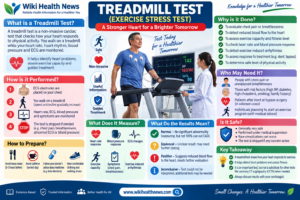
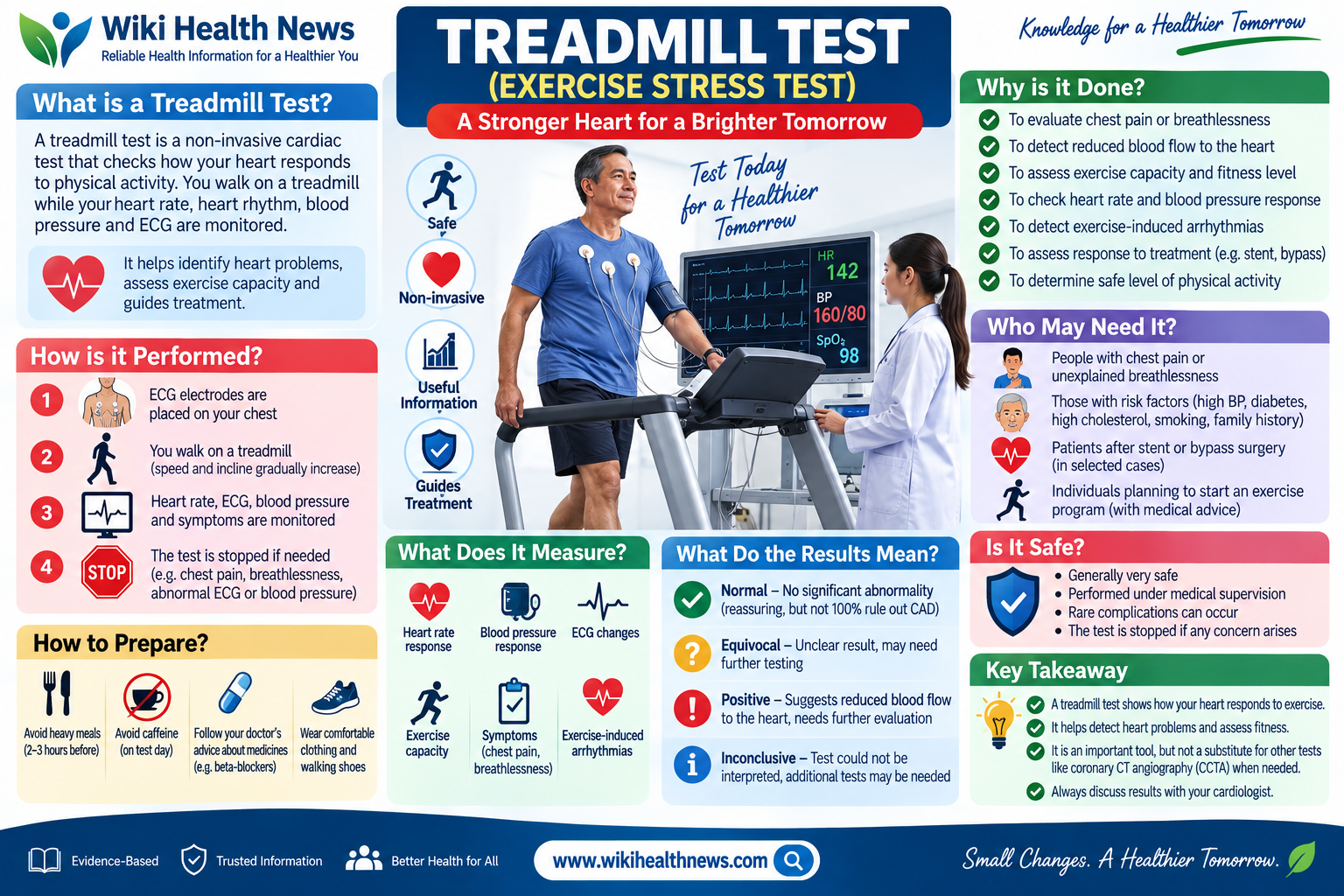
A treadmill test, also called an exercise stress test or exercise ECG, is a common cardiac investigation used to assess how the heart responds to physical activity. During the test, you walk on a treadmill while your heart rate, heart rhythm, blood pressure, ECG and symptoms are monitored.
As exercise intensity increases, the heart needs more oxygen and must pump more blood. If the blood supply to the heart cannot increase adequately, exercise may trigger symptoms or ECG changes that provide useful diagnostic information. The American Heart Association’s exercise stress test guide explains that exercise testing can provide information about how well the heart handles physical activity and can help evaluate certain heart conditions.
For patients with chest pain, however, the treadmill test is only one possible investigation. Depending on the patient’s symptoms and clinical risk, doctors may consider coronary CT angiography (CCTA), stress echocardiography, nuclear stress imaging, cardiac MRI or other investigations.
What Is a Treadmill Test?
A treadmill test measures the response of your cardiovascular system to progressively increasing exercise.
You are connected to an electrocardiogram (ECG) machine, and a blood-pressure cuff is placed around your arm. You then walk on a treadmill while the speed and incline gradually increase.
The medical team monitors:
- Heart rate
- Heart rhythm
- ECG changes
- Blood pressure
- Exercise duration
- Exercise capacity
- Chest discomfort
- Breathlessness
- Dizziness
- Fatigue
The American Heart Association notes that exercise stress testing is closely monitored and can be stopped when necessary.
For additional information about ECG testing, patients can also read our ECG Test Guide on Wiki Health News.
Why Is a Treadmill Test Done?
A treadmill test may be recommended for several reasons.
1. Evaluation of chest pain
If chest discomfort occurs during exercise, a treadmill test may help determine whether the symptoms are associated with exercise-induced myocardial ischemia.
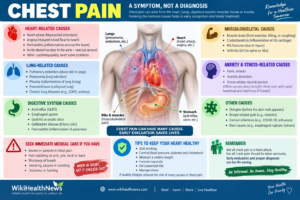
Patients should understand that not every episode of chest pain is caused by coronary artery disease. Gastroesophageal, musculoskeletal, pulmonary and other causes may also produce chest discomfort.
Read our patient guide to chest pain and its common causes for more information.
2. Assessment of suspected coronary artery disease
Exercise testing may provide evidence of myocardial ischemia through symptoms and ECG changes.
However, the diagnostic strategy should be individualized. The 2024 ESC Guidelines for Chronic Coronary Syndromes recommend structured assessment of the likelihood of obstructive coronary artery disease and appropriate selection of anatomical or functional testing.
3. Assessment of exercise capacity
A treadmill test can determine how well a person tolerates progressively increasing workloads.
Exercise capacity is clinically useful in many cardiovascular conditions and can help doctors understand functional status and prognosis.
4. Evaluation of exercise-related arrhythmias
Some abnormal heart rhythms become more apparent during exercise.
The American Heart Association’s information on arrhythmia testing explains that exercise testing can sometimes provoke an arrhythmia, allowing the healthcare team to study it.
5. Assessment after treatment
In selected patients, exercise testing may be used to assess the response to treatment or determine an appropriate level of physical activity.
The purpose and timing of testing after angioplasty, stenting or bypass surgery should be determined by the treating cardiologist.
How Is a Treadmill Test Performed?
The test generally follows several steps.
Step 1: Preparation
You will usually be asked to wear comfortable clothing and suitable walking shoes.
The healthcare team will review your medical history, medications and symptoms.
Step 2: ECG electrodes
Small adhesive electrodes are placed on the chest to continuously record your ECG.
Step 3: Baseline measurements
Your resting heart rate, blood pressure and ECG are recorded before exercise begins.
Step 4: Exercise
You begin walking at a relatively low workload.
The treadmill speed and incline are gradually increased according to the selected protocol.
Step 5: Monitoring
Your ECG, heart rate, blood pressure and symptoms are monitored throughout the test.
Step 6: Recovery
After exercise stops, you remain under observation while your heart rate, blood pressure and ECG gradually recover.
The test may be stopped at any time if symptoms or concerning findings develop.
What Should You Do Before a Treadmill Test?
Your hospital or cardiac laboratory will provide specific instructions.
Generally:
- Wear comfortable exercise clothing.
- Wear proper walking or sports shoes.
- Avoid a heavy meal shortly before the test if instructed.
- Tell the doctor about all medications.
- Inform the team about previous heart problems.
- Report any significant symptoms before starting.
What about beta-blockers?
Beta-blockers and some other medications can reduce the heart-rate response to exercise.
Whether these medications should be continued or temporarily withheld depends on why the test is being performed.
Never stop a prescribed cardiac medication on your own.
Your cardiologist or testing center should provide specific instructions.
What Happens During the Test?
During exercise, the treadmill gradually becomes more difficult.
You may experience:
- Increasing breathing rate
- Sweating
- Leg fatigue
- Increased heart rate
- Mild breathlessness
These responses are expected with exercise.
However, you should immediately report:
- Chest pressure or pain
- Severe breathlessness
- Dizziness
- Near-fainting
- Palpitations
- Severe fatigue
- Any unusual symptoms
The healthcare team can stop the test if necessary.
What Does the Treadmill Test Measure?
A treadmill test provides several important measurements.
Heart rate response
The heart rate should increase appropriately with exercise.
An inadequate heart-rate response may occur because of medications, conduction disease, autonomic dysfunction or other conditions.
Blood-pressure response
Blood pressure normally changes during exercise. An abnormal response may provide additional clinical information.
ECG response
The ECG is examined for changes that may suggest myocardial ischemia or other abnormalities.
Exercise capacity
Exercise duration and workload provide information about functional capacity.
Symptoms
The relationship between exercise and symptoms is an important component of interpretation.
What Is a Positive Treadmill Test?
A positive exercise ECG generally means that the test has demonstrated predefined findings that may indicate myocardial ischemia.
ECG changes must be interpreted together with:
- Symptoms
- Exercise capacity
- Baseline ECG
- Heart rate response
- Blood-pressure response
- Cardiovascular risk factors
- Overall clinical probability of coronary artery disease
A positive result does not automatically mean that a major coronary artery is completely blocked.
Additional testing may be necessary.
What Is a Negative Treadmill Test?
A negative treadmill test means that the predefined abnormal findings being assessed were not demonstrated during the test.
This can be reassuring, but it does not mean that every form of coronary artery disease has been excluded.
A patient with persistent or typical symptoms may still require further evaluation.
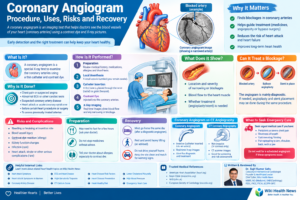
Can a Treadmill Test Detect Coronary Blockage?
A treadmill test does not directly visualize coronary arteries.
It assesses the physiological response to exercise.
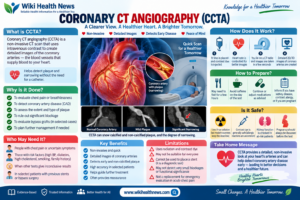
If your doctor needs to see the coronary arteries directly, a test such as coronary CT angiography (CCTA) may be considered in an appropriate patient.
CCTA can provide anatomical information about coronary plaque and narrowing, while stress testing evaluates the physiological response of the heart.
Treadmill Test vs CCTA
These tests answer different questions.
| Treadmill Test | CCTA |
|---|---|
| Functional assessment | Anatomical assessment |
| Uses exercise | Uses CT imaging |
| Records ECG changes | Visualizes coronary arteries |
| Assesses exercise capacity | Shows plaque and coronary narrowing |
| Can detect exercise-induced arrhythmias | Shows coronary anatomy |
| No CT radiation | Uses X-ray radiation |
| Does not directly visualize blockages | Directly visualizes coronary arteries |
The 2024 ESC Chronic Coronary Syndromes guideline includes exercise ECG, CCTA and functional imaging within the diagnostic framework, with the choice depending on the clinical situation.
The ACC/AHA chest pain guideline similarly emphasizes structured assessment and selection of anatomical or functional testing according to clinical risk and circumstances.
Is a Treadmill Test Better Than CCTA?
Neither test is universally better.
A treadmill test may be particularly useful when the doctor wants information about:
- Exercise capacity
- Exercise-induced symptoms
- Exercise blood-pressure response
- Exercise-induced arrhythmias
- Functional response to exercise
CCTA may be particularly useful when the clinical question is about:
- Coronary anatomy
- Coronary plaque
- Coronary stenosis
- Presence or absence of obstructive CAD
Your cardiologist should select the investigation according to the diagnostic question.
Can a Treadmill Test Detect Arrhythmias?
Yes.
Some arrhythmias occur primarily during exercise or become more frequent with exertion.
The American Heart Association’s arrhythmia testing information notes that exercise testing may help identify arrhythmias triggered by physical activity.
If palpitations occur unpredictably rather than specifically during exercise, your doctor may instead consider ambulatory ECG monitoring such as a Holter monitor.
Is the Treadmill Test Safe?
For appropriately selected patients, exercise stress testing is generally safe and is performed under medical supervision.
The American Heart Association states that exercise stress tests are usually safe and closely monitored.
Nevertheless, exercise places additional demand on the cardiovascular system, so rare complications can occur.
The test should be performed in an appropriate medical setting with trained personnel and the ability to respond to complications.
Who May Not Be Suitable for a Treadmill Test?
Not everyone can safely or adequately perform an exercise treadmill test.
The suitability of the test may be affected by:
- Severe physical disability
- Inability to walk safely
- Certain unstable cardiac conditions
- Severe symptomatic aortic stenosis
- Acute illness
- Significant uncontrolled arrhythmias
- Severe musculoskeletal limitations
The decision must be individualized by the treating medical team.
What If I Cannot Walk on a Treadmill?
If you cannot exercise sufficiently, your doctor may consider a pharmacological stress test.
Depending on the clinical question, options may include:
- Stress echocardiography
- Nuclear myocardial perfusion imaging
- Stress cardiac MRI
These tests can assess the heart’s response to stress without requiring conventional treadmill exercise.
Can a Normal Treadmill Test Rule Out Heart Disease?
No.
A normal treadmill test can be reassuring but does not exclude all forms of cardiovascular disease.
For example, coronary artery disease may be present without producing diagnostic ECG changes during exercise.
Some patients with persistent symptoms may require additional testing.
It is also possible to have coronary microvascular dysfunction or vasospastic disease despite non-obstructive coronary arteries.
When Is Further Testing Needed?
Further testing may be considered when:
- Symptoms remain unexplained.
- Symptoms are strongly suggestive of angina.
- The treadmill result is equivocal.
- The test is technically inadequate.
- Exercise capacity was insufficient.
- There is a high clinical suspicion of CAD despite a negative test.
- The resting ECG makes interpretation difficult.
- Anatomical information is required.
Depending on the circumstances, further evaluation may include CCTA, stress echocardiography, nuclear imaging, cardiac MRI or invasive coronary angiography.
Treadmill Test and Heart Attack
A treadmill test is not a test for diagnosing an acute heart attack.
If someone develops sudden chest pressure, severe breathlessness, sweating, nausea, fainting or pain spreading to the arm, jaw, neck or back, emergency medical evaluation is required.
Read our patient information about heart attack symptoms and warning signs.
Do not wait for a routine treadmill test if you have symptoms suggesting an acute coronary syndrome.
How Are Treadmill Results Interpreted?
A treadmill report may include:
- Exercise duration
- Maximum workload
- Maximum heart rate
- Blood-pressure response
- ECG findings
- Symptoms
- Reason for stopping
- Recovery response
- Arrhythmias
- Overall interpretation
Doctors should interpret the result in the context of the patient’s pre-test probability of coronary artery disease.
The 2024 ESC guidelines use a structured clinical-likelihood approach for suspected chronic coronary syndromes and emphasize selecting the appropriate diagnostic test rather than applying one test to every patient.
What Does Exercise Capacity Tell Us?
Exercise capacity is an important part of the treadmill test.
A person who can exercise for a longer duration and achieve a higher workload without concerning symptoms generally demonstrates better functional capacity than someone who develops symptoms at a very low workload.
Exercise capacity is influenced by:
- Age
- Sex
- Fitness
- Obesity
- Lung disease
- Anemia
- Heart disease
- Medications
- Musculoskeletal limitations
Therefore, the result should always be interpreted in context.
Can Treadmill Testing Be Used for Fitness Assessment?
In selected individuals, exercise testing can help establish functional capacity and an appropriate exercise level.
However, people with known heart disease or significant cardiovascular risk should discuss vigorous exercise plans with their healthcare professional.
The goal should be safe, sustainable physical activity, not simply achieving the highest possible treadmill workload.
Key Takeaway
A treadmill test is a useful cardiovascular investigation that evaluates how the heart responds to exercise.
It can provide information about:
Exercise capacity → Heart rate → Blood pressure → ECG → Symptoms → Arrhythmias
However, a treadmill test does not directly show coronary blockages.
For some patients, CCTA or stress imaging may provide more appropriate diagnostic information. The correct test depends on symptoms, cardiovascular risk, baseline ECG, ability to exercise and the specific clinical question.
For more cardiovascular education, explore our Heart Health Guide on Wiki Health News.
30 Frequently Asked Questions About Treadmill Tests
1. What is a treadmill test?
A treadmill test is an exercise stress test that monitors the ECG, heart rate, blood pressure and symptoms while a person exercises.
2. What is another name for a treadmill test?
It is also called an exercise stress test, exercise ECG or exercise treadmill test.
3. Why is a treadmill test performed?
It may be used to evaluate chest pain, exercise-related symptoms, exercise capacity, blood-pressure response and certain exercise-induced arrhythmias. The American Heart Association provides detailed patient information about exercise stress testing.
4. Can a treadmill test detect heart blockage?
It cannot directly visualize a coronary blockage. It looks for physiological and ECG evidence that may suggest myocardial ischemia.
5. Can a treadmill test diagnose a heart attack?
No. Suspected acute myocardial infarction requires urgent medical assessment, ECG and appropriate cardiac biomarkers.
6. How long does a treadmill test take?
The exercise portion is usually relatively short, but preparation and recovery add to the total appointment time.
7. Is a treadmill test painful?
The test itself is generally not painful, although you may become tired or breathless. Chest discomfort can occur if exercise triggers your symptoms.
8. Can I stop the treadmill test?
Yes. You should tell the testing team immediately if you develop concerning symptoms. The test can be stopped when medically appropriate.
9. What happens if I cannot walk on a treadmill?
Your doctor may recommend an alternative stress test, such as pharmacological stress echocardiography, nuclear imaging or stress cardiac MRI.
10. What is the target heart rate?
The target depends on age, medications and the purpose of the test. A specific heart rate should not be interpreted without considering the entire test.
11. Do beta-blockers affect treadmill testing?
Yes. Beta-blockers can reduce the heart-rate response to exercise. Your doctor will decide whether they should be continued or withheld.
12. Should I stop my heart medicines?
No medication should be stopped without specific medical instructions.
13. Can I eat before a treadmill test?
Instructions vary. Your testing center may advise you to avoid a heavy meal before the examination.
14. Can I drink coffee before a treadmill test?
Follow the instructions from your testing center. Requirements may differ depending on the type of stress test.
15. What should I wear?
Wear comfortable clothing and appropriate walking or sports shoes.
16. What does a positive treadmill test mean?
It means the test demonstrated predefined findings that may suggest myocardial ischemia or another abnormal cardiovascular response.
17. What does a negative treadmill test mean?
It means the test did not demonstrate the predefined abnormal findings being assessed. It does not guarantee that all coronary disease has been excluded.
18. Can a treadmill test be falsely positive?
Yes. Exercise ECG can produce abnormal findings in patients who do not have significant obstructive coronary artery disease.
19. Can a treadmill test be falsely negative?
Yes. A normal exercise ECG cannot exclude every form of coronary artery disease.
20. How accurate is a treadmill test?
Accuracy varies according to patient selection and clinical circumstances. Contemporary guidelines emphasize appropriate test selection and may favor CCTA or stress imaging in many patients with suspected chronic coronary syndromes.
21. Can a treadmill test detect arrhythmias?
Yes. Exercise may provoke certain arrhythmias, allowing the healthcare team to document them.
22. Can a treadmill test measure exercise capacity?
Yes. Exercise duration and workload provide information about functional capacity.
23. Can a treadmill test detect abnormal blood-pressure response?
Yes. Blood pressure is monitored during exercise and recovery.
24. Can a treadmill test be performed after a heart attack?
It may be appropriate in selected clinically stable patients, depending on the timing and purpose of the test.
25. Can someone with a coronary stent undergo a treadmill test?
Yes, when clinically appropriate. The timing and reason for testing should be determined by the treating cardiologist.
26. Can a treadmill test be performed after bypass surgery?
It may be useful in selected patients. The choice of test depends on symptoms, clinical circumstances and timing after surgery.
27. What happens after an abnormal treadmill test?
Your doctor may recommend additional evaluation such as CCTA, stress imaging or invasive coronary angiography depending on the overall clinical picture.
28. Is a treadmill test better than CCTA?
Neither is universally better. A treadmill test provides functional information, while CCTA provides anatomical information about the coronary arteries.
29. Can I exercise normally after the test?
Most people can resume normal activity after recovery unless their doctor provides different instructions.
30. Who should interpret my treadmill test?
A qualified healthcare professional should interpret the test together with your symptoms, medical history, ECG findings, exercise capacity and cardiovascular risk.
Author Card
Dr. Sujit Kumar Sahu
Consultant Interventional Cardiologist
MBBS, MD (General Medicine), DNB (Cardiology), FSCAI, FESC, ICCPR-CRFC, FACC
Dr. Sujit Kumar Sahu is a Consultant Interventional Cardiologist with expertise in cardiovascular disease, coronary interventions and patient-focused cardiac education.
Article: Treadmill Test / Exercise Stress Test
Content Type: Patient Education
Specialty: Cardiology
Publisher: Wiki Health News
Medical Disclaimer: This article is intended for general educational purposes and does not replace an individual medical consultation, diagnosis or treatment plan. Patients with new, severe or worsening chest pain should seek urgent medical evaluation.
References
- American Heart Association — Exercise Stress Test. Patient information covering the procedure, monitoring, indications and safety of exercise stress testing.
Read the American Heart Association exercise stress test guide. - European Society of Cardiology — 2024 Guidelines for the Management of Chronic Coronary Syndromes. Current guidance on clinical likelihood assessment and selection of diagnostic testing for suspected chronic coronary syndromes.
Read the 2024 ESC Chronic Coronary Syndromes Guidelines. - European Society of Cardiology — 2024 Pocket Guidelines for Chronic Coronary Syndromes. The diagnostic pathway includes exercise ECG, CCTA, functional imaging and invasive testing according to the clinical situation.
View the ESC Pocket Guidelines. - American College of Cardiology — 2021 AHA/ACC Chest Pain Guideline. Provides a structured approach to selecting diagnostic testing for patients with acute and stable chest pain.
Read the ACC chest pain guideline summary. - American Heart Association — Common Tests for Arrhythmia. Includes the role of exercise stress testing in evaluating exercise-related arrhythmias.
Read the AHA arrhythmia testing guide.