CT Calcium Score
Absolutely. Here is an SEO-friendly, patient-focused article on CT Calcium Score (Coronary Artery Calcium Score) suitable for Wiki Health News.
CT Calcium Score: What It Is, Normal Range, Uses, and What Your Score Means
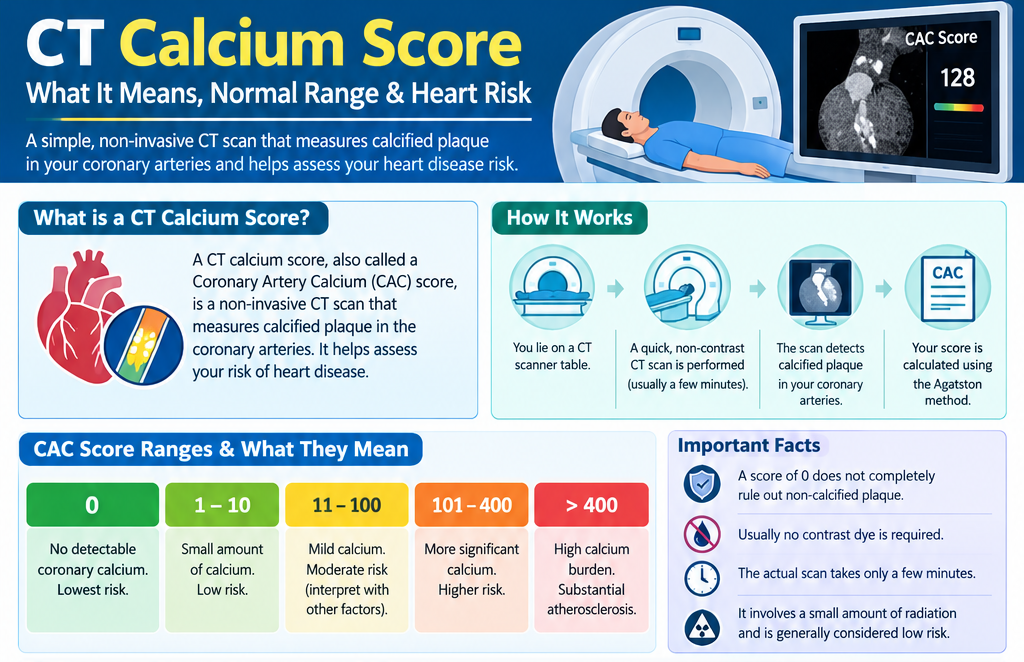
A CT calcium score, also called a Coronary Artery Calcium (CAC) score, is a non-invasive heart test that measures the amount of calcium-containing plaque in the coronary arteries. It can help estimate a person’s risk of developing coronary artery disease (CAD) and future cardiovascular events.
Calcium in the coronary arteries is a marker of atherosclerosis, the process in which fatty and fibrous deposits build up inside artery walls. A higher calcium score generally indicates a greater burden of coronary atherosclerosis.
What Is a CT Calcium Score?
A CT calcium score is obtained using a specialized non-contrast CT scan of the heart. The scan usually takes only a few minutes and does not require an injection of contrast dye.
The test detects calcified plaque in the coronary arteries and calculates a numerical score, commonly reported using the Agatston score.
Importantly, a calcium score does not directly tell you whether a coronary artery is severely narrowed. Instead, it estimates the overall burden of calcified coronary plaque.
Why Is a Calcium Score Done?
A CAC scan can be useful when the decision about preventive treatment—particularly cholesterol-lowering therapy—is uncertain.
It may help doctors assess cardiovascular risk in selected people who:
- Have risk factors for coronary artery disease
- Have high cholesterol
- Have hypertension
- Have diabetes or prediabetes
- Smoke or previously smoked
- Have a family history of premature heart disease
- Have an intermediate or uncertain estimated cardiovascular risk
- Want additional information about their cardiovascular risk after discussion with their doctor
The test is generally more useful for risk assessment in people without symptoms than for diagnosing an acute heart attack.
CT Calcium Score: Understanding the Numbers
A commonly used interpretation is:
| CAC Score | Interpretation |
|---|---|
| 0 | No detectable coronary calcium |
| 1–10 | Minimal calcium |
| 11–100 | Mild plaque burden |
| 101–400 | Moderate plaque burden |
| >400 | Extensive plaque burden |
These categories are useful for general understanding, but the clinical significance also depends on age, sex, risk factors and symptoms.
What Does a Calcium Score of 0 Mean?
A CAC score of 0 means that no detectable calcified plaque was identified on the scan.
This is generally associated with a lower short- to intermediate-term risk of coronary events, although it does not mean that coronary artery disease is impossible.
A calcium score can be zero even when:
- Early non-calcified plaque is present
- A person has significant cardiovascular risk factors
- Symptoms are caused by another cardiac or non-cardiac condition
Therefore, a score of 0 should not automatically be interpreted as “I cannot have heart disease.”
What Does a High Calcium Score Mean?
A high CAC score indicates a greater amount of calcified plaque in the coronary arteries and generally corresponds to a higher cardiovascular risk.
For example, a score above 400 indicates a substantial coronary calcium burden.
However, the number should not be interpreted in isolation. A score of 150 in a younger person may have a different clinical significance from the same score in an older person.
Doctors may consider the age- and sex-adjusted percentile in addition to the absolute calcium score.
Does Calcium Score Show Blocked Arteries?
Not directly.
A CAC scan identifies and measures calcified plaque, but it does not reliably determine the percentage of narrowing in each coronary artery.
For example, a person can have:
- A high calcium score without one critical blockage
- A relatively low calcium score with non-calcified plaque
- Symptoms despite a low or zero calcium score
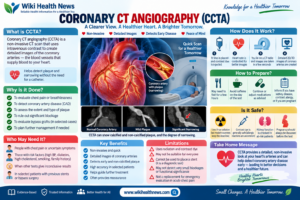
If someone has symptoms suggestive of coronary artery disease, the doctor may recommend other tests such as CT coronary angiography, stress testing or invasive coronary angiography, depending on the clinical situation.
Who Should Consider a Calcium Score?
CAC testing is particularly useful when cardiovascular risk is not clearly low or high and the result could change preventive treatment decisions.
It is usually not necessary for everyone.
For a person already known to have coronary artery disease, a calcium score generally adds little because the presence of disease is already established.
Similarly, it is not usually the first test for someone experiencing symptoms of an acute coronary syndrome.
How Is the Test Performed?
The procedure is simple:
- You lie on the CT scanner table.
- ECG electrodes are placed on your chest.
- The scanner obtains images synchronized with your heartbeat.
- No contrast injection is generally required.
- The calcium score is calculated from the CT images.
The actual scanning time is usually very short.
Is CT Calcium Scoring Safe?
CAC scanning involves a small amount of radiation exposure. Modern CT scanners and protocols are designed to keep radiation exposure as low as reasonably achievable.
Because it involves radiation, the test should be performed when there is a reasonable clinical indication.
Pregnancy is an important consideration, and patients should inform their healthcare professional if they are pregnant or may be pregnant.
Does a Calcium Score Predict a Heart Attack?
The CAC score is a risk marker, not a prediction that a heart attack will definitely occur.
In general:
Higher CAC → greater coronary plaque burden → higher cardiovascular risk.
A calcium score can therefore help identify people who may benefit from more intensive prevention.
But risk is also influenced by:
- LDL cholesterol
- Blood pressure
- Diabetes
- Smoking
- Age
- Family history
- Kidney disease
- Lifestyle
- Other cardiovascular risk factors
Can a Calcium Score Go Down?
Once calcium has developed in an artery, the calcium itself generally does not simply disappear.
Treatment is aimed at reducing cardiovascular risk and preventing plaque progression and cardiovascular events, rather than trying to make the calcium score zero.
Important preventive measures include:
- Controlling LDL cholesterol
- Managing blood pressure
- Maintaining a healthy weight
- Regular physical activity
- Avoiding tobacco
- Managing diabetes
- Following a heart-healthy diet
- Taking prescribed medications consistently
Calcium Score and Statin Treatment
One of the important clinical uses of CAC scoring is helping with decisions about statin therapy in selected adults when the need for treatment is uncertain.
A CAC score of 0 may allow some people to defer statin therapy, depending on their overall risk and circumstances. Exceptions can include people with certain high-risk features, such as diabetes, significant smoking exposure or a strong family history of premature coronary disease.
A CAC score of 100 or higher, or a high age/sex percentile, generally provides stronger evidence in favor of preventive lipid-lowering treatment when clinically appropriate.
The decision should always be individualized by a healthcare professional.
CT Calcium Score vs CT Coronary Angiography
These two tests are different.
| Feature | CT Calcium Score | CT Coronary Angiography |
|---|---|---|
| Contrast dye | Usually no | Usually yes |
| Measures calcium | Yes | Yes |
| Shows coronary anatomy | Limited | Yes |
| Detects non-calcified plaque | No/limited | Yes |
| Evaluates narrowing | Not reliably | Yes |
| Main purpose | Risk assessment | Evaluation of coronary disease |
The appropriate test depends on whether the goal is risk assessment or evaluation of suspected coronary artery disease.
Important Limitations
A CAC score should never be interpreted as a standalone diagnosis.
A zero score does not eliminate the possibility of:
- Non-calcified plaque
- Future coronary disease
- Coronary spasm
- Microvascular disease
- Other causes of chest pain
Likewise, a high score does not necessarily mean that a person has a single severe blockage requiring a stent.
The result should be interpreted together with the person’s clinical history, symptoms and cardiovascular risk profile.
Key Takeaways
- CT calcium scoring is a quick, non-invasive test for detecting calcified coronary plaque.
- The Agatston score is commonly used to quantify coronary calcium.
- CAC = 0 generally indicates a low burden of detectable calcified plaque.
- Higher scores indicate greater coronary atherosclerotic burden and generally higher cardiovascular risk.
- A calcium score does not directly measure coronary artery blockage.
- CAC testing can help guide preventive treatment decisions in selected people.
- A high score does not automatically mean that a stent or angioplasty is required.
- Lifestyle modification and appropriate risk-factor treatment remain essential regardless of the score.
About the Author
Dr. Sujit Kumar Sahu is a Consultant Interventional Cardiologist and medical educator with expertise in cardiovascular disease prevention, diagnosis, medical management, and interventional cardiology. He holds MBBS, MD (Medicine), and DNB (Cardiology) qualifications, along with professional fellowships and certifications including FESC, FACC, FSCAI, and ICCPR-CRFC.
Dr. Sahu has a special interest in heart disease prevention, coronary artery disease, cardiovascular risk assessment, hypertension, lipid disorders, coronary interventions, and preventive cardiology. His approach focuses on translating complex cardiovascular information into clear, evidence-based guidance for patients and readers.
As the Founder & Chief Editor of Wiki Health News, Dr. Sahu contributes to health education content designed to help readers understand medical investigations, cardiovascular risk factors, prevention strategies, and treatment options.
This article on CT Calcium Score (Coronary Artery Calcium Score) provides general educational information about coronary calcium, cardiovascular risk assessment, interpretation of calcium scores, and the role of CAC testing in preventive cardiology. Clinical decisions should always be individualized according to a patient’s symptoms, medical history and overall cardiovascular risk. CAC scoring is primarily a risk-assessment tool and does not by itself determine the presence or severity of a coronary artery blockage.
Author: Dr. Sujit Kumar Sahu
Designation: Consultant Interventional Cardiologist
Qualifications: MBBS, MD (Medicine), DNB (Cardiology)
Fellowships: FESC, FACC, FSCAI
Certification: ICCPR-CRFC
Role: Founder & Chief Editor, Wiki Health News
Here are 20 concise, SEO-friendly FAQs with answers for your CT Calcium Score article.
CT Calcium Score — 20 FAQs
1. What is a CT calcium score?
A CT calcium score, or Coronary Artery Calcium (CAC) score, is a non-invasive CT scan that measures calcified plaque in the coronary arteries.
2. What is a normal CT calcium score?
A CAC score of 0 means no detectable coronary artery calcium was found. It generally indicates a low burden of calcified coronary plaque.
3. What does a calcium score of 0 mean?
A score of 0 means no detectable calcified plaque was identified. However, it does not completely rule out non-calcified plaque or future heart disease.
4. What does a calcium score of 100 mean?
A CAC score of 100 indicates a measurable burden of coronary calcium and is associated with increased cardiovascular risk compared with a score of 0.
5. What does a calcium score above 400 mean?
A score above 400 indicates a high burden of coronary artery calcium and generally suggests substantial coronary atherosclerosis.
6. Does a high calcium score mean blocked arteries?
Not necessarily. CAC measures calcified plaque but does not directly determine how severely an individual coronary artery is narrowed.
7. Can a calcium score of 0 still mean heart disease is present?
Yes. A zero score does not completely exclude non-calcified plaque or other forms of cardiovascular disease.
8. Is a CT calcium score the same as a CT coronary angiogram?
No. A calcium scan primarily measures coronary calcium, while CT coronary angiography provides detailed images of the coronary arteries, including plaque and narrowing.
9. Does a CT calcium score require contrast dye?
Usually, no. A standard coronary calcium scan is performed using non-contrast CT.
10. Is a CT calcium score painful?
No. It is a non-invasive test and does not normally involve needles or contrast injection.
CT Calcium Score
11. How long does a calcium score test take?
The actual CT scan is usually completed within a few minutes, although preparation and registration may take additional time.
12. Who should consider a CT calcium score?
It may be useful for selected adults whose cardiovascular risk is uncertain and when the result could help guide preventive treatment decisions.
13. Can a calcium score help determine whether I need a statin?
Yes. CAC scoring can help refine decisions about preventive cholesterol-lowering treatment in appropriately selected patients.
14. Can a high calcium score be reversed?
Established coronary calcium generally does not simply disappear. Treatment focuses on reducing cardiovascular risk and preventing progression and complications.
15. Can exercise reduce coronary calcium?
Exercise may significantly improve cardiovascular health and reduce overall risk, but it should not be expected to remove established calcium deposits.
16. Can diet reduce calcium in the coronary arteries?
A heart-healthy diet can improve cholesterol, blood pressure, weight and metabolic health. It is an important part of reducing cardiovascular risk, although it does not necessarily remove existing calcium.
17. Is a CT calcium score safe?
CAC scanning is generally considered low risk, but it does involve a small amount of radiation. The test should be performed when clinically appropriate.
18. Can a calcium score predict a heart attack?
It cannot predict exactly if or when a heart attack will occur. However, a higher CAC score is associated with a higher risk of cardiovascular events.
19. Should people with chest pain get a calcium score?
Not necessarily. Chest pain requires appropriate clinical assessment, and depending on the situation, tests such as ECG, troponin, CT coronary angiography or stress testing may be more appropriate.
20. What should I do if my calcium score is high?
Discuss the result with your cardiologist. Management may include controlling LDL cholesterol, blood pressure, diabetes, smoking, weight, diet and physical activity, with additional cardiac testing when appropriate.
Medical disclaimer: This article is for educational purposes and does not replace an individual medical evaluation. People with chest pain, breathlessness, sweating, fainting or other possible symptoms of a heart attack should seek urgent medical care rather than waiting for a calcium-score test.
References
- American College of Cardiology / American Heart Association — 2026 Guideline for the Management of Dyslipidemia
The updated guideline supports selective use of non-contrast CAC scanning for cardiovascular risk assessment when treatment decisions remain uncertain.
ACC — 2026 Dyslipidemia Guideline Update - Society of Cardiovascular Computed Tomography (SCCT) — Guidelines & Scientific Documents
SCCT maintains guidance and consensus documents covering coronary calcium scoring, cardiovascular CT and CAC reporting.
SCCT Guidelines & Scientific Documents - SCCT/STR — Guidelines for Coronary Artery Calcium Scoring
Provides technical guidance concerning coronary artery calcium scoring using CT.
SCCT/STR Coronary Calcium Scoring Guideline - SCCT — CAC-DRS: Coronary Artery Calcium Data and Reporting System
Provides a standardized framework for reporting coronary artery calcium findings. - SCCT — Clinical Indications for Coronary Artery Calcium Scoring in Asymptomatic Patients
Consensus guidance addressing appropriate clinical use of CAC scoring.
SCCT Clinical Guidelines and Consensus Documents
CT Calcium Score
1. What is a CT calcium score?
A CT calcium score, or coronary artery calcium (CAC) score, is a non-invasive CT scan that detects and measures calcified plaque in the coronary arteries. It is primarily used to help assess cardiovascular risk.
2. What is another name for a CT calcium score?
It is also called a coronary artery calcium score, CAC score, coronary calcium scan, or Agatston score.
3. What does a calcium score measure?
It measures the amount of calcified plaque in the coronary arteries. The result provides information about the burden of coronary atherosclerosis.
4. What is an Agatston score?
The Agatston score is a commonly used numerical method for quantifying coronary artery calcium detected on CT.
5. Is a calcium score of 0 good?
Generally, yes. A CAC score of 0 means no detectable coronary calcium was identified. It is generally associated with a lower cardiovascular risk, although it does not completely exclude non-calcified plaque or future heart disease.
6. What is considered a normal calcium score?
A CAC score of 0 is generally considered the lowest-risk category because no detectable coronary calcium is present. Clinical interpretation should also consider age, sex and other risk factors.
7. What does a calcium score of 1–10 mean?
A score of 1–10 indicates a small amount of detectable coronary calcium. It suggests that calcified coronary plaque is present, even though the burden is relatively low.
8. What does a calcium score of 11–100 mean?
A score in this range indicates mild coronary calcium, although interpretation depends on the person’s age, sex and overall cardiovascular risk.
9. What does a calcium score above 100 mean?
A score above 100 indicates a more significant burden of coronary calcium and is generally associated with increased cardiovascular risk. The result should be interpreted in the context of the individual’s overall risk profile.
10. What does a calcium score above 400 mean?
A CAC score above 400 represents a high burden of coronary artery calcium and generally indicates substantial coronary atherosclerosis. Further cardiovascular risk assessment may be appropriate.
11. Does a high calcium score mean I have a blocked artery?
Not necessarily. A CAC scan measures calcified plaque, not the exact percentage of narrowing inside an artery. Additional testing may be needed when clinically indicated.
12. Can you have a heart attack with a calcium score of 0?
Yes. A zero score substantially lowers the likelihood of significant calcified plaque but does not eliminate the possibility of non-calcified plaque or other causes of cardiovascular events.
13. Does a calcium score show soft plaque?
A standard CAC scan is designed primarily to detect calcified plaque. It is not a comprehensive test for non-calcified or “soft” plaque.
14. Is a CT calcium score the same as CT coronary angiography?
No. A calcium scan is usually a non-contrast CT examination that quantifies coronary calcium. CT coronary angiography uses contrast and provides much more detailed information about coronary anatomy, plaque and narrowing.
15. Who should have a CT calcium score?
CAC testing may be considered in selected adults when cardiovascular risk is borderline or intermediate and the result could help guide preventive treatment decisions. The 2026 ACC/AHA dyslipidemia guideline recommends selective CAC use when uncertainty about treatment remains.
16. Is a calcium score useful for people with high cholesterol?
It can be useful in selected people when the need for preventive treatment is uncertain. However, a calcium score should not be used as a substitute for appropriate cholesterol management.
17. Can a calcium score help decide whether I need a statin?
Yes. CAC can help refine preventive treatment decisions in appropriately selected patients. A CAC score of zero may support deferring statin therapy in some lower- or intermediate-risk people without other major cardiovascular conditions, while detectable calcium generally strengthens the case for lipid-lowering treatment.
18. Does everyone with a calcium score of 0 avoid statins?
No. A zero CAC score does not automatically mean that statin therapy is unnecessary. Other factors, including diabetes, smoking, family history, LDL cholesterol and overall cardiovascular risk, must be considered.
19. Does a calcium score increase with age?
Coronary calcium generally becomes more common with increasing age. Therefore, the age- and sex-related percentile can be useful when interpreting an individual’s result.
20. Can a calcium score go down?
The amount of coronary calcium generally does not simply disappear with treatment. The goal of treatment is to reduce cardiovascular risk and prevent plaque-related complications, rather than necessarily lowering the CAC number.
21. Can exercise reduce my calcium score?
Exercise is important for cardiovascular health and can reduce overall cardiovascular risk, but it should not be expected to make established coronary calcium disappear.
22. Does diet affect coronary calcium?
A heart-healthy diet can help improve cholesterol, blood pressure, weight and metabolic health and may reduce cardiovascular risk. Diet is therefore an important part of managing cardiovascular risk even when coronary calcium is present.
23. Is a CT calcium score painful?
No. The test is non-invasive and does not normally require an injection. You simply lie on the CT scanner while images are obtained.
24. Does a calcium score require contrast dye?
Usually, no contrast dye is required for a standard coronary artery calcium scan.
25. How long does a calcium score test take?
The actual CT scan is usually very quick and typically takes only a few minutes, although the total time at the imaging center may be longer.
26. Is CT calcium scoring safe?
It is generally considered a low-risk test, but it involves exposure to a small amount of ionizing radiation. Radiation exposure should be minimized and the test should be performed when clinically appropriate. SCCT has published guidance specifically addressing radiation optimization for CAC scanning.
27. Can a calcium score diagnose a heart attack?
No. CAC scoring is primarily a risk-assessment tool and is not the appropriate test for diagnosing an acute heart attack.
28. Should I get a calcium score if I have chest pain?
That depends on the clinical situation. Chest pain requires assessment based on symptoms, risk factors and clinical findings. Depending on the circumstances, a healthcare professional may recommend ECG, blood tests, CT coronary angiography, stress testing or other investigations rather than a standalone CAC scan.
29. How often should a calcium score be repeated?
There is no single interval that applies to everyone. The decision to repeat CAC testing should be individualized based on age, baseline score, risk factors and whether the result would change management.
30. What should I do if my calcium score is high?
Discuss the result with your cardiologist or physician. Management may include assessment and treatment of LDL cholesterol, blood pressure, diabetes, smoking, weight, diet and physical activity, along with additional cardiac evaluation when clinically indicated.