TLC Diet
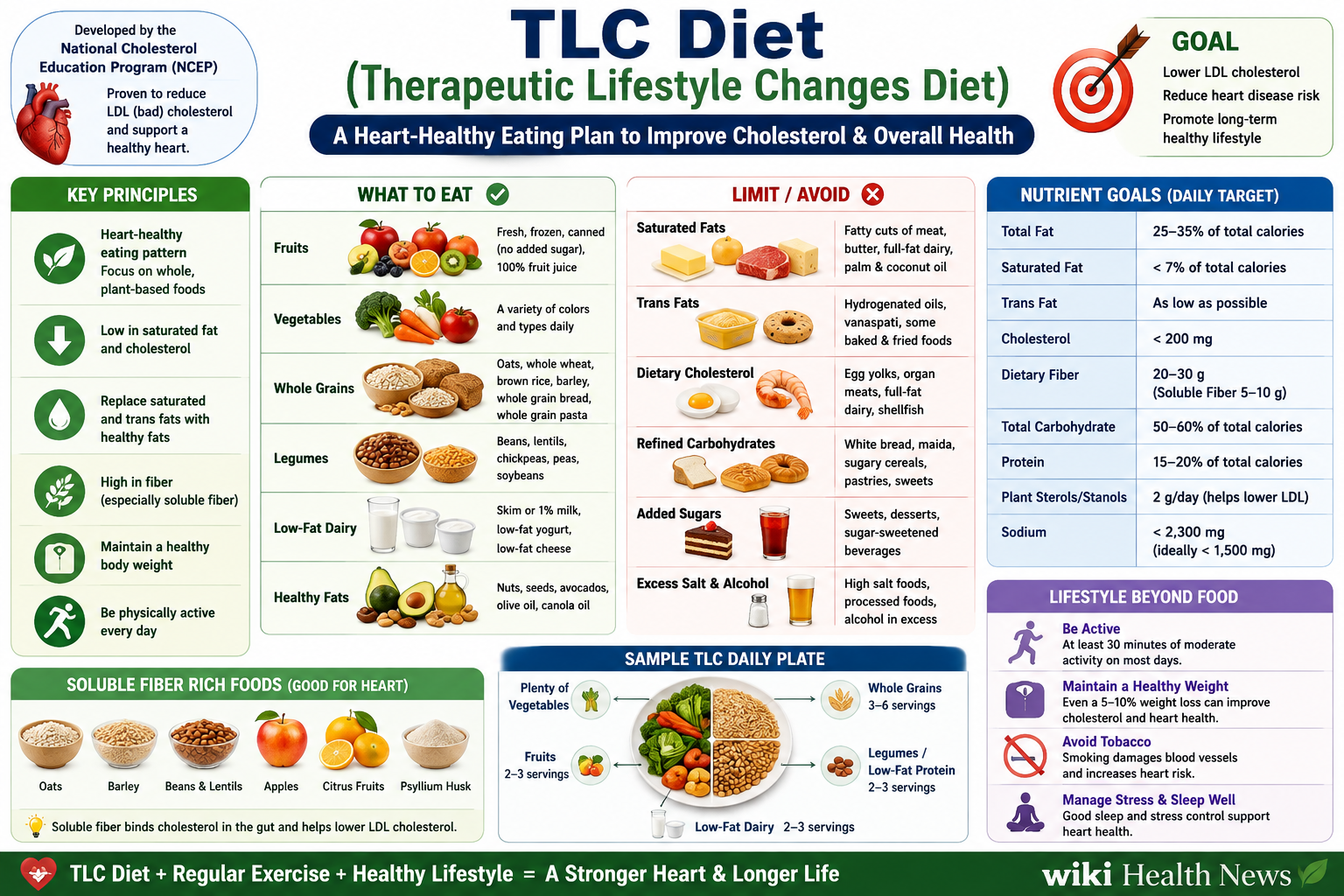
Written by: Wiki Health News Medical Editorial Team
Medically Reviewed by: Dr. Sujit Kumar Sahu, MBBS, MD [Medicine], DrNB [Cardiology]
Last Medically Reviewed: August 2026
Last Updated: August 2026
Evidence level: Established dietary and lifestyle recommendations
Primary source: National Heart, Lung, and Blood Institute (NHLBI)
Additional evidence: American Heart Association dietary guidance
TLC Diet (Therapeutic Lifestyle Changes Diet)
The TLC Diet (Therapeutic Lifestyle Changes Diet) is a heart-healthy eating plan developed by the National Heart, Lung, and Blood Institute (NHLBI) to help lower LDL cholesterol and reduce cardiovascular disease risk.
The TLC approach combines dietary changes with physical activity and weight management. Its main focus is reducing saturated fat and dietary cholesterol while increasing soluble fiber and incorporating foods that support healthy blood cholesterol levels.
Key Principles of the TLC Diet
| TLC recommendation | Main goal |
|---|---|
| Reduce saturated fat | Lower LDL cholesterol |
| Avoid trans fats | Improve cardiovascular health |
| Increase soluble fiber | Help reduce cholesterol absorption |
| Include plant sterols/stanols | Reduce intestinal cholesterol absorption |
| Choose lean protein | Reduce saturated-fat intake |
| Eat more fruits & vegetables | Increase fiber and nutrients |
| Maintain healthy weight | Improve lipid and metabolic health |
| Regular physical activity | Support cardiovascular health |
Foods to Emphasize
The TLC Diet encourages:
- Oats and whole grains
- Beans, lentils and chickpeas
- Fruits and vegetables
- Fish and lean protein
- Skinless poultry
- Nuts and seeds in appropriate portions
- Low-fat or fat-free dairy products
- Foods containing soluble fiber
- Plant sterol/stanol-containing foods when appropriate
Foods to Limit
Foods particularly high in saturated fat should be reduced, including:
- Butter
- Ghee
- Fatty meats
- Processed meats
- Full-fat dairy products
- Fried foods
- High-fat bakery products
- Foods containing trans fats
TLC Diet for Indian Patients
The TLC Diet can be adapted easily to Indian cuisine. A typical day might include:
Breakfast: Oats with fruit and low-fat milk or unsweetened soy milk.
Lunch: Dal or rajma, vegetables and whole-wheat roti.
Snack: Fruit or a small portion of unsalted nuts.
Dinner: Grilled fish, tofu or dal with vegetables and a moderate portion of whole grains.
Cooking methods such as steaming, grilling, roasting and sautéing with modest amounts of unsaturated oil can help reduce unnecessary saturated-fat intake.
TLC Diet vs Portfolio Diet
Both diets can help with cholesterol management, but their emphasis differs.
| Feature | TLC Diet | Portfolio Diet |
|---|---|---|
| Main focus | Reduce saturated fat and LDL cholesterol | Combine several LDL-lowering foods |
| Soluble fiber | Important | Important |
| Plant sterols | Included | Important component |
| Nuts | Encouraged | Important component |
| Plant protein | Encouraged | Important component |
| Saturated-fat reduction | Central principle | Important |
| Exercise/weight management | Explicit component | Usually part of broader lifestyle |
The TLC Diet is particularly useful when the primary objective is reducing dietary factors that raise LDL cholesterol, while the Portfolio Diet deliberately combines multiple cholesterol-lowering dietary components.
TLC Diet (Therapeutic Lifestyle Changes): A Heart-Healthy Diet to Lower LDL Cholesterol
What Is the TLC Diet?
The TLC Diet (Therapeutic Lifestyle Changes Diet) is a heart-healthy eating and lifestyle program developed by the National Heart, Lung, and Blood Institute (NHLBI) to help lower LDL cholesterol and improve cardiovascular health. The program combines three major strategies: heart-healthy eating, physical activity, and weight management.
The dietary approach emphasizes reducing saturated fat and cholesterol while increasing soluble fiber and plant sterols or stanols. The TLC program is not intended as a short-term crash diet; it is designed as a sustainable lifestyle approach.
How Does the TLC Diet Lower LDL Cholesterol?
The TLC Diet focuses particularly on reducing foods high in saturated fat, because saturated fat can raise LDL cholesterol. Traditional TLC recommendations also include increasing soluble fiber and plant sterols or stanols to provide additional LDL-lowering effects.
The NHLBI guide describes a TLC pattern with less than 7% of calories from saturated fat, less than 200 mg of dietary cholesterol daily, and increased soluble fiber. The program also includes physical activity and achieving or maintaining a healthy weight.
Current cardiovascular nutrition guidance continues to emphasize vegetables, fruits, whole grains, healthy protein sources and replacing saturated fats with unsaturated fats.
Key TLC Diet Foods
| Food group | Indian examples | Why include them? |
|---|---|---|
| Whole grains | Oats, barley, whole-wheat roti | Fiber and complex carbohydrates |
| Legumes | Dal, rajma, chana, peas | Plant protein and fiber |
| Vegetables | Spinach, beans, gourds, carrots | Fiber and micronutrients |
| Fruits | Apple, orange, guava, papaya | Fiber and plant nutrients |
| Healthy fats | Nuts, seeds, appropriate vegetable oils | Unsaturated fats |
| Protein | Fish, skinless poultry, tofu, pulses | Lower-saturated-fat choices |
| Low-fat dairy | Low-fat milk, curd | Protein and calcium |
Indian TLC Diet Meal Plan
A practical Indian TLC Diet can be simple and familiar.
Breakfast: Oats or barley porridge with fruit and low-fat milk, or vegetable oats.
Lunch: Dal or rajma, mixed vegetables and whole-wheat roti. Alternatively, use a moderate serving of brown rice.
Snack: Guava, apple, orange, roasted chana or a small portion of unsalted nuts.
Dinner: Grilled fish, tofu, dal or chickpeas with vegetables and whole grains.
Use herbs, spices, lemon, garlic, ginger and other seasonings instead of relying heavily on salt. NHLBI recommends limiting sodium to 2,300 mg per day within the TLC program.
For more heart-health and nutrition information, readers can also explore WikiHealthNews and Femelife.
Foods to Limit on the TLC Diet
Limit foods rich in saturated fat, including fatty meats, processed meats, butter, large amounts of ghee, full-fat dairy products, fried foods and high-fat bakery products. The goal is to replace saturated-fat-rich foods with healthier unsaturated-fat and plant-based choices.
Physical activity is also an essential part of TLC. Regular activity can support weight management and improve several cardiovascular risk factors.
TLC Diet and LDL Cholesterol
The TLC program can produce substantial LDL reductions when its components are followed consistently. NHLBI educational material estimates that the combined dietary and lifestyle interventions can potentially reduce LDL cholesterol substantially, depending on individual response and adherence.
People with very high LDL cholesterol, established cardiovascular disease, diabetes, or other significant risk factors may require medication in addition to lifestyle changes. Treatment should be individualized with a healthcare professional.
Conclusion
The TLC Diet is a practical cholesterol-lowering lifestyle program centered on reducing saturated fat, increasing fiber-rich plant foods, choosing healthier fats, maintaining a healthy weight and staying physically active. Its principles can be adapted easily to traditional Indian meals.
30 Frequently Asked Questions About the TLC Diet
1. What does TLC stand for?
TLC stands for Therapeutic Lifestyle Changes.
2. What is the TLC Diet?
It is a heart-healthy dietary and lifestyle program designed primarily to help lower LDL cholesterol.
The TLC program was developed by the National Heart, Lung, and Blood Institute (NHLBI).
Yes. Reducing saturated fat, increasing soluble fiber and using other TLC strategies can help lower LDL cholesterol.
Yes. It is designed to improve cholesterol and other cardiovascular risk factors.
6. What foods are included in the TLC Diet?
Vegetables, fruits, whole grains, legumes, nuts, seeds, fish, lean proteins and low-fat dairy can all fit into the diet.
7. Can I eat oats on the TLC Diet?
Yes. Oats are an excellent source of soluble fiber.
8. Is barley allowed?
Yes. Barley is a whole grain and provides soluble fiber.
9. Can I eat dal on the TLC Diet?
Yes. Dal is an excellent source of plant protein and dietary fiber.
10. Are rajma and chana allowed?
Yes. Rajma, chana and other legumes are suitable TLC foods.
11. Can Indians follow the TLC Diet?
Yes. The principles can be easily adapted to Indian foods and cooking styles.
12. Can I eat roti on the TLC Diet?
Yes. Whole-wheat roti can be included in appropriate portions.
13. Can I eat rice?
Yes. Portion control is important, and whole-grain options can be used more often.
14. Can I eat ghee?
Ghee is high in saturated fat, so it should generally be used sparingly when following a cholesterol-lowering diet.
15. Can I eat butter?
Butter is high in saturated fat and should be limited.
16. Are nuts allowed?
Yes. Unsalted nuts can provide healthy unsaturated fats, fiber and other nutrients.
17. Can I eat fruit?
Yes. Whole fruits are encouraged as sources of fiber and micronutrients.
18. Can I drink milk?
Low-fat or fat-free milk can fit into the TLC Diet.
19. Can I eat fish?
Yes. Fish can be an appropriate protein choice, particularly when prepared without excessive saturated fat.
20. Is the TLC Diet vegetarian?
It can be followed as a vegetarian diet by emphasizing legumes, soy, whole grains, nuts and seeds.
21. Can the TLC Diet be vegan?
Yes. Animal products can be replaced with plant-based protein and fortified foods as appropriate.
22. Does the TLC Diet help with weight loss?
It can support weight management when calorie intake is appropriate and combined with physical activity.
23. How much saturated fat should I consume?
Traditional TLC recommendations target less than 7% of daily calories from saturated fat for LDL lowering. Individual targets should be discussed with a healthcare professional.
24. How much soluble fiber is recommended?
Traditional TLC guidance recommends increasing soluble fiber, with approximately 10–25 g/day used as an LDL-lowering option in the program.
25. What are plant sterols and stanols?
They are plant compounds that can reduce intestinal cholesterol absorption and may help lower LDL cholesterol.
26. Can the TLC Diet replace statins?
Not necessarily. Some people require medication in addition to lifestyle changes.
27. How long does the TLC Diet take to lower cholesterol?
Cholesterol response varies. A lipid profile can help determine whether the lifestyle changes are working.
28. Is the TLC Diet the same as the Portfolio Diet?
No. They overlap, but the TLC Diet places particular emphasis on reducing saturated fat and cholesterol while incorporating soluble fiber and plant sterols/stanols. The Portfolio Diet deliberately combines several cholesterol-lowering food components.
29. Can people with diabetes follow the TLC Diet?
Yes, but carbohydrate portions and overall meal planning should be individualized.
30. What is the most important principle of the TLC Diet?
The central principle is to make sustainable lifestyle changes that reduce LDL cholesterol and cardiovascular risk through diet, physical activity and healthy weight management.
References
- National Heart, Lung, and Blood Institute. Therapeutic Lifestyle Changes (TLC). National Institutes of Health. NHLBI: Therapeutic Lifestyle Changes
- National Heart, Lung, and Blood Institute. Your Guide to Lowering Your Cholesterol With TLC: Therapeutic Lifestyle Changes. NHLBI TLC Guide
- National Heart, Lung, and Blood Institute. Blood Cholesterol—Treatment. NHLBI Blood Cholesterol Treatment
- Lichtenstein AH, Khera A, Anderson CAM, et al. 2026 Dietary Guidance to Improve Cardiovascular Health: A Scientific Statement From the American Heart Association. Circulation. 2026. American Heart Association: 2026 Dietary Guidance
Portfolio Diet, Heart Attack Prevention, Family History of Heart Disease, and other cardiovascular nutrition articles on WikiHealthNews and relevant women’s health content on Femelife.