BNP / NT-proBNP: What These Heart Failure Blood Tests Mean, Normal Levels, Uses & Interpretation
BNP / NT-proBNP: What These Heart Failure Blood Tests Mean, Normal Levels, Uses & Interpretation
Focus Keyword: BNP / NT-proBNP
SEO Title: BNP / NT-proBNP: Normal Levels, Heart Failure Test & Interpretation
Meta Description:
Suggested Slug: bnp-nt-probnp-heart-failure-test
Introduction
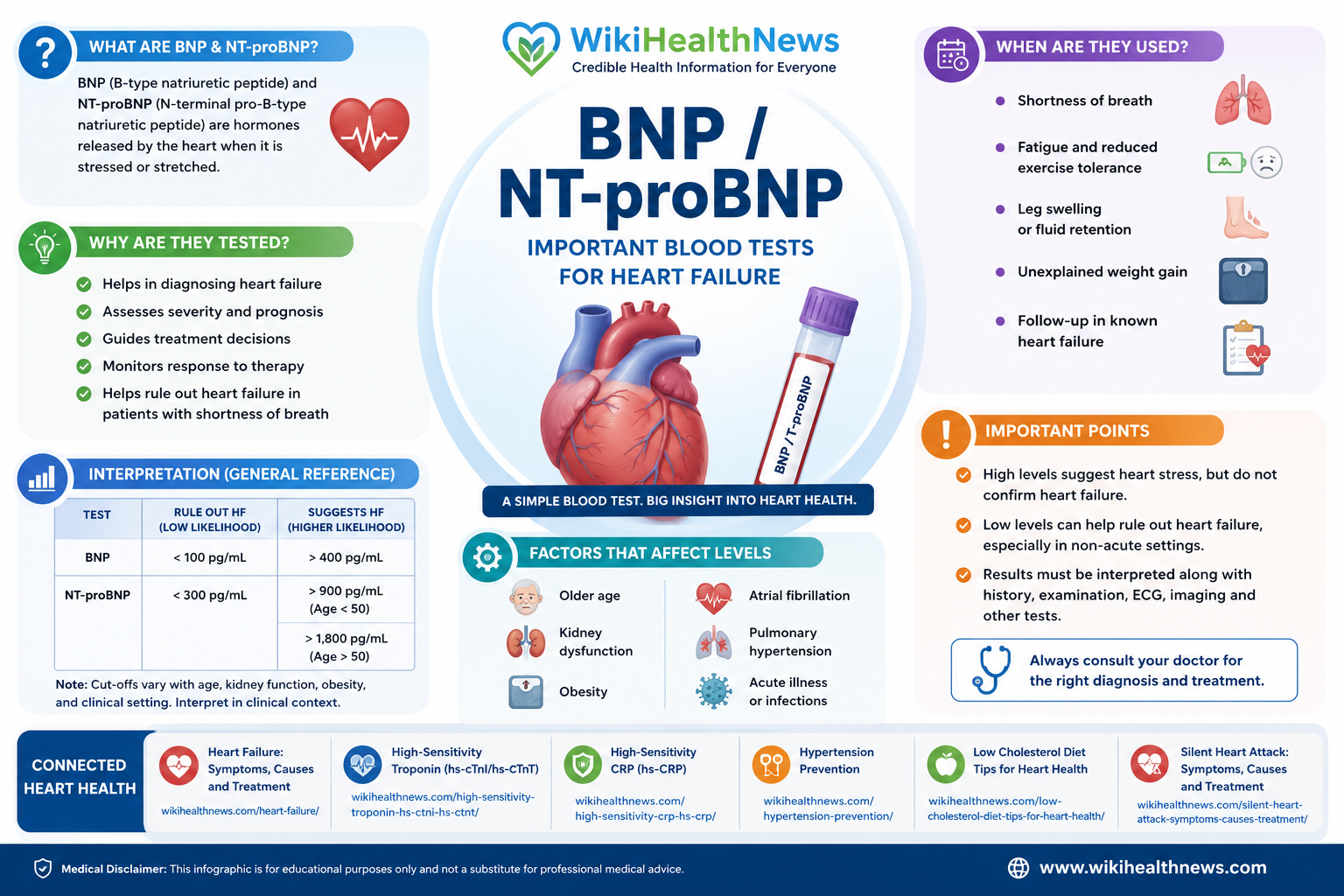
BNP (B-type natriuretic peptide) and NT-proBNP (N-terminal pro-B-type natriuretic peptide) are important blood biomarkers used in the evaluation of suspected heart failure. They are released when the heart is exposed to increased pressure or stretching. Testing BNP or NT-proBNP can help doctors support or exclude a diagnosis of heart failure, particularly in patients presenting with symptoms such as breathlessness. (MedlinePlus)
These tests are valuable, but they should not be interpreted in isolation. Age, kidney function, obesity, atrial fibrillation and other medical conditions can influence natriuretic peptide concentrations.
What Is BNP?
BNP is a hormone produced primarily by the heart in response to increased cardiac wall stress. It promotes blood-vessel relaxation and increased urinary sodium and water excretion, helping reduce the workload on the heart. (MedlinePlus)
When the heart is under increased pressure or volume stress, BNP levels may rise. Therefore, an elevated BNP can be a useful clue in patients with suspected heart failure.
What Is NT-proBNP?
NT-proBNP is an inactive fragment released when the precursor molecule is processed to produce BNP. Like BNP, NT-proBNP increases when the heart experiences increased wall stress. (MedlinePlus)
Both tests are clinically useful, although BNP and NT-proBNP are not interchangeable numerically. The laboratory’s assay and reference range should always be considered when interpreting a result.
Why Are BNP and NT-proBNP Tested?
The American Heart Association/American College of Cardiology/Heart Failure Society of America guideline recommends BNP or NT-proBNP measurement in patients presenting with dyspnea when heart failure is suspected because these biomarkers can support diagnosis or exclusion of heart failure. They can also be used for risk stratification in people with established chronic heart failure. (www.heart.org)
Common clinical uses include:
- Evaluating unexplained shortness of breath
- Supporting or excluding suspected heart failure
- Assessing the severity and prognosis of heart failure
- Risk stratification
- Monitoring selected patients with established heart failure
- Helping distinguish cardiac causes of symptoms from some non-cardiac causes
The test is generally interpreted together with history, physical examination, ECG, chest imaging and echocardiography rather than being used as a stand-alone diagnosis. (www.heart.org)
BNP vs NT-proBNP: What’s the Difference?
| Feature | BNP | NT-proBNP |
|---|---|---|
| Full name | B-type natriuretic peptide | N-terminal pro-B-type natriuretic peptide |
| Biological role | Active hormone | Inactive peptide fragment |
| Released with cardiac wall stress | Yes | Yes |
| Used in suspected heart failure | Yes | Yes |
| Used for risk assessment | Yes | Yes |
| Interpretation | Depends on assay and clinical setting | Depends on assay, age and clinical setting |
A key point is that there is no single universal “normal” number that applies to every patient and every clinical situation. Cutoffs vary according to whether testing is performed in an acute or non-acute setting, the assay used, and patient characteristics.
What Does a High BNP or NT-proBNP Mean?
An elevated result may indicate increased cardiac wall stress and can occur with heart failure. However, a high BNP or NT-proBNP does not automatically prove that heart failure is present.
Levels can also be influenced by conditions such as:
- Kidney dysfunction
- Atrial fibrillation
- Older age
- Pulmonary hypertension
- Certain valvular heart diseases
- Acute coronary syndromes
- Other conditions associated with cardiac stress
Conversely, obesity can be associated with comparatively lower natriuretic peptide concentrations, so a relatively low result should be interpreted in the overall clinical context.
Can a Normal BNP or NT-proBNP Rule Out Heart Failure?
In appropriate clinical settings, a low natriuretic peptide level can make heart failure substantially less likely, particularly in patients presenting with breathlessness. MedlinePlus notes that normal BNP or NT-proBNP levels can usually help rule out heart failure in a person with shortness of breath, although clinical assessment remains essential. (MedlinePlus)
BNP / NT-proBNP and Echocardiography
BNP or NT-proBNP testing does not replace echocardiography.
An echocardiogram can evaluate:
- Left ventricular ejection fraction
- Chamber size
- Valve abnormalities
- Diastolic function
- Right ventricular function
- Pulmonary pressure estimates
- Structural heart disease
A raised natriuretic peptide level may indicate cardiac stress, while echocardiography helps determine the underlying cardiac abnormality.
BNP / NT-proBNP in Heart Failure Risk Assessment
Natriuretic peptide concentrations can provide prognostic information in people with established heart failure. The AHA/ACC/HFSA guideline recommends BNP or NT-proBNP measurements for risk stratification in chronic heart failure. (www.heart.org)
The interpretation of changing values should be individualized. A single elevated value should not automatically be interpreted as treatment failure, and serial testing is most useful when the clinical question is clearly defined.
Important Factors That Affect BNP / NT-proBNP
Doctors consider several factors before interpreting the result:
Age: Natriuretic peptide levels tend to increase with age.
Kidney function: Reduced renal function may increase NT-proBNP and BNP concentrations.
Obesity: Obesity can be associated with lower-than-expected natriuretic peptide concentrations.
Atrial fibrillation: AF can increase natriuretic peptide levels even without classic left-sided heart failure.
Acute illness: Acute cardiac or systemic conditions can alter levels.
Therefore, the result should always be interpreted alongside symptoms, examination findings and other investigations.
BNP / NT-proBNP: Key Takeaway
BNP and NT-proBNP are powerful tools for evaluating suspected heart failure, but they are not standalone diagnostic tests. A result must be interpreted according to the clinical setting, laboratory assay and patient characteristics.
Current heart-failure guidance continues to recognize natriuretic peptides as important biomarkers, while the 2026 Second Universal Definition of Heart Failure further emphasizes accurate phenotyping, early detection and recognition of conditions that can mimic heart failure. (professional.heart.org)
Trusted External References
- American Heart Association – Diagnosing Heart Failure
- AHA/ACC/HFSA Heart Failure Guideline
- European Society of Cardiology – Heart Failure Guidelines
- MedlinePlus – BNP and NT-proBNP Test
- 2026 Second Universal Definition of Heart Failure – AHA
Author
Dr. Sujit Kumar Sahu
Consultant Interventional Cardiologist
Qualifications: MBBS, MD (General Medicine), DrNB (Cardiology), FESC, FACC, FSCAI, ICCPR-CRFC
Dr. Sujit Kumar Sahu is a Consultant Interventional Cardiologist with an interest in coronary artery disease, heart failure, preventive cardiology and contemporary cardiovascular care.
Author profile: Add your verified Wiki Health News author-profile URL here.
Medical Disclaimer: This article is intended for educational purposes and does not replace an individual medical consultation. BNP or NT-proBNP results should be interpreted by a qualified healthcare professional in the context of symptoms, examination findings and other investigations.