Electrolytes and Heart Disease: Potassium, Sodium, Magnesium & Calcium
Electrolytes and Heart Disease
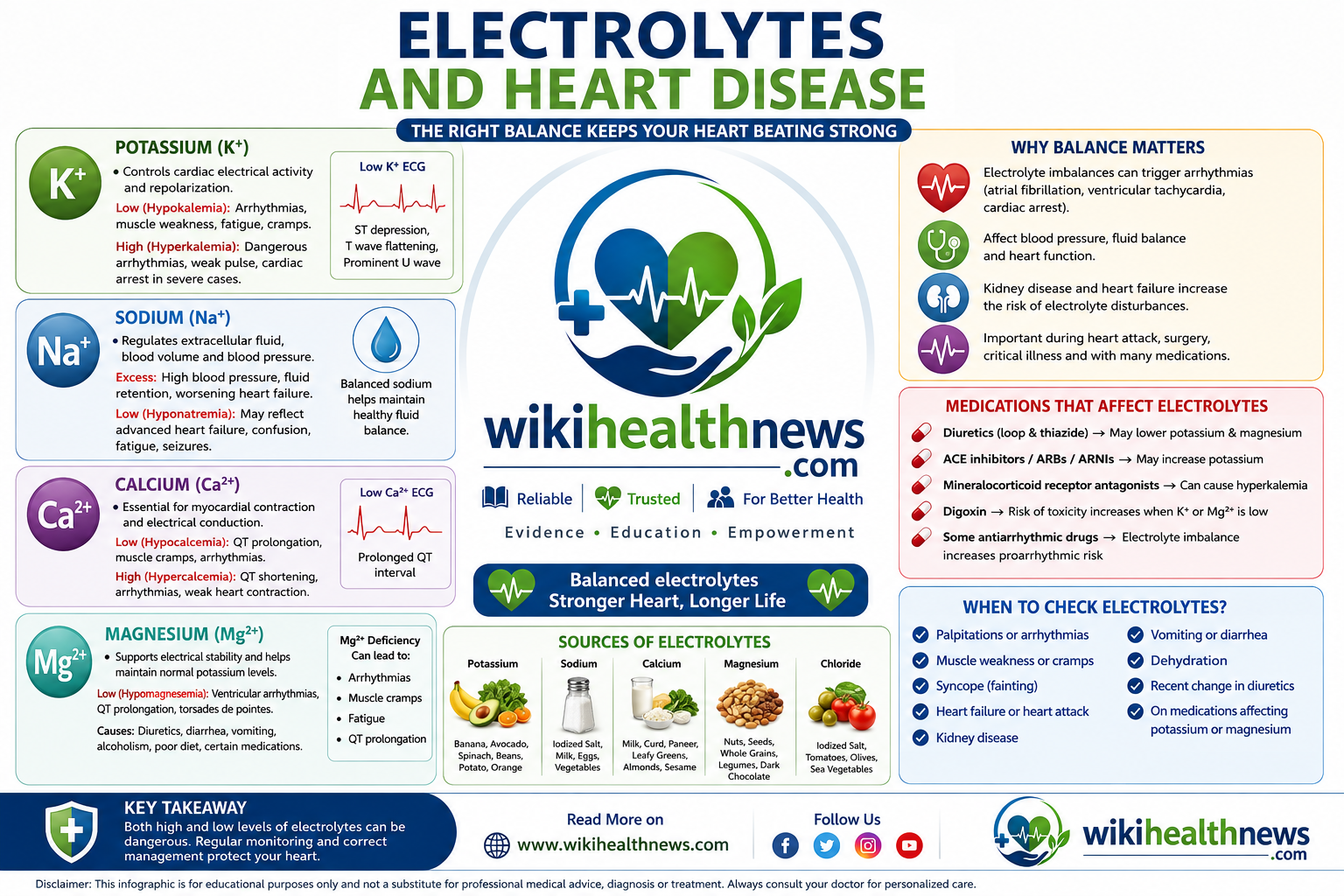
Electrolytes are minerals that carry an electrical charge and are essential for normal heart function. The most important electrolytes for cardiovascular health include sodium, potassium, calcium, magnesium, and chloride. Abnormal electrolyte levels can affect the heart’s electrical activity, blood pressure, muscle contraction, and fluid balance.
How electrolytes affect the heart
| Electrolyte | Main cardiovascular role | What abnormal levels can cause |
|---|---|---|
| Potassium (K⁺) | Controls cardiac electrical activity and repolarization | Arrhythmias, weakness, cardiac arrest in severe cases |
| Sodium (Na⁺) | Regulates extracellular fluid and blood volume | Hypertension, fluid retention; severe abnormalities can affect neurologic function |
| Calcium (Ca²⁺) | Important for myocardial contraction and electrical conduction | QT changes, arrhythmias, impaired contraction |
| Magnesium (Mg²⁺) | Supports electrical stability and potassium balance | Ventricular arrhythmias, QT prolongation, torsades de pointes |
| Chloride (Cl⁻) | Helps maintain fluid and acid-base balance | Usually accompanies disturbances in sodium/fluid balance |
1. Potassium: particularly important in heart disease
Both hypokalemia and hyperkalemia can be dangerous.
Low potassium may occur with diuretics, vomiting, diarrhea, or certain endocrine disorders. It can produce ECG changes such as ST depression, T-wave flattening and prominent U waves, and can increase susceptibility to atrial and ventricular arrhythmias.
High potassium is commonly associated with kidney dysfunction and medications that interfere with the renin–angiotensin–aldosterone system. Severe hyperkalemia can cause progressive conduction abnormalities and potentially fatal ventricular arrhythmias.
Patients with heart failure, chronic kidney disease, or those taking ACE inhibitors, ARBs, ARNIs, mineralocorticoid receptor antagonists, or potassium supplements may therefore require periodic potassium monitoring.
2. Sodium and heart failure
Sodium is closely related to extracellular fluid volume.
Excess dietary sodium can contribute to fluid retention and increased blood pressure, which is particularly relevant in patients with hypertension and heart failure.
However, hyponatremia in advanced heart failure is often not simply caused by inadequate dietary sodium. It may reflect increased water retention due to neurohormonal activation and can be a marker of more advanced disease.
Therefore, patients with heart failure should not independently start taking large amounts of salt or electrolyte supplements to correct a low sodium result.
3. Magnesium and arrhythmias
Magnesium plays an important role in myocardial electrical stability.
Hypomagnesemia can contribute to ventricular arrhythmias and may be associated with torsades de pointes, particularly when potassium is also low.
Low magnesium can occur with diuretic therapy, gastrointestinal losses, malnutrition, alcohol-related disorders, and some medications.
When unexplained or recurrent ventricular arrhythmias occur, magnesium should be considered along with potassium and other metabolic abnormalities.
4. Calcium and cardiac conduction
Calcium is essential for myocardial contraction and participates in the cardiac action potential.
Significant hypocalcemia can prolong the QT interval, while hypercalcemia may shorten the QT interval. Severe abnormalities can produce clinically important arrhythmias and changes in myocardial contractility.
Calcium interpretation should take into account factors such as albumin concentration and, when appropriate, ionized calcium.
Electrolytes after a heart attack
Electrolyte abnormalities can become particularly important during acute myocardial infarction.
Ischemic myocardium is electrically unstable, and disturbances in potassium or magnesium can further increase the risk of arrhythmias. Electrolytes are therefore commonly monitored in patients with acute coronary syndromes, especially when arrhythmias, kidney dysfunction, vomiting, or diuretic therapy are present.
Electrolytes and common cardiac medications
Several cardiovascular drugs can alter electrolyte levels:
- Loop and thiazide diuretics → may lower potassium and magnesium.
- ACE inhibitors/ARBs/ARNI → can increase potassium, particularly with kidney dysfunction.
- Mineralocorticoid receptor antagonists → can cause hyperkalemia.
- Digoxin → toxicity risk increases when potassium or magnesium is low.
- Some antiarrhythmic drugs → electrolyte abnormalities can increase proarrhythmic risk.
Should heart patients take electrolyte drinks?
Not routinely.
Many commercial electrolyte drinks contain substantial amounts of sodium and/or potassium, and some contain considerable sugar. A person with heart failure, kidney disease, hypertension, or medications affecting potassium should not routinely use electrolyte supplements without a specific indication.
For most people, a balanced diet and adequate hydration provide sufficient electrolytes.
When should electrolytes be checked?
Testing is particularly important when a cardiac patient has:
- Palpitations or unexplained arrhythmia
- Muscle weakness or cramps
- Syncope
- Acute kidney injury or chronic kidney disease
- Vomiting or prolonged diarrhea
- Significant dehydration
- Recent changes in diuretic therapy
- Treatment with medications that affect potassium or magnesium
- Heart failure or acute coronary syndrome
Bottom line: Electrolytes are fundamental to normal cardiac electrical activity and myocardial contraction. Both excessively high and excessively low levels can be dangerous. In patients with heart disease, electrolyte management should be individualized according to the underlying cardiac condition, kidney function, medications, and laboratory results.
Absolutely. For the “Electrolytes and Heart Disease” article, I would add a combination of authoritative external references plus internal links to your Wiki Health News / Medicine Question Bank content.
Suggested internal links
Use these naturally within the article:
- Heart attack risk factors → Wiki Health News – Heart Attack Risk Factors
- Heart failure → Wiki Health News – Heart Failure
- Blood pressure and hypertension → Wiki Health News – Hypertension & Heart Health
- Cardiac arrhythmias → Medicine Question Bank – Cardiology Questions
- Cardiology MCQs for medical students → Medicine Question Bank – Cardiology
- ECG interpretation → Medicine Question Bank
SEO tip: If you have specific existing URLs for these articles, use those exact URLs rather than linking everything to the homepage. This creates much stronger contextual internal linking.
Recommended external references
- American Heart Association – Heart FailureThe AHA notes that hyperkalemia can occur in heart failure, particularly because of kidney dysfunction or medications, and that potassium abnormalities can affect cardiac rhythm. (www.heart.org)
AHA – Heart Failure Explained - American Heart Association – Heart Failure MedicationsDiuretics can cause potassium and magnesium loss, while supplementation may sometimes be required depending on laboratory results and clinical circumstances. (www.heart.org)
AHA – Medications Used to Treat Heart Failure - 2023 ACC/AHA/ACCP/HRS Atrial Fibrillation GuidelineThe guideline emphasizes monitoring potassium and magnesium because hypokalemia and hypomagnesemia increase the risk of drug-associated QT prolongation and torsades de pointes with certain antiarrhythmic drugs. (AHA Journals)
2023 ACC/AHA/ACCP/HRS Atrial Fibrillation Guideline - American Heart Association – Advanced Life Support GuidelinesThe AHA discusses electrolyte correction in torsades de pointes, including correction of hypokalemia and the role of intravenous magnesium. (AHA Journals)
AHA – Adult Advanced Life Support Guidelines - ESC Heart Failure GuidelinesThe European Society of Cardiology provides evidence-based recommendations for diagnosis and management of acute and chronic heart failure, including pharmacological and clinical monitoring considerations. (Escardio)
ESC – Heart Failure Guidelines - 2026 ESC Heart Failure GuidelinesThe newly published 2026 ESC guideline provides updated recommendations for heart-failure classification and management. (Escardio)
2026 ESC Guidelines for Heart Failure - 2022 AHA/ACC/HFSA Heart Failure GuidelineThis remains an important reference for evidence-based heart-failure management and pharmacological therapy. (professional.heart.org)
AHA/ACC/HFSA Heart Failure Guideline
Reference list for the bottom of the article
References
- Heidenreich PA, et al. 2022 AHA/ACC/HFSA Guideline for the Management of Heart Failure. Circulation. AHA/ACC/HFSA Heart Failure Guideline
- Joglar JA, et al. 2023 ACC/AHA/ACCP/HRS Guideline for the Diagnosis and Management of Atrial Fibrillation. Circulation. Full AF Guideline
- American Heart Association. Medications Used to Treat Heart Failure. AHA Heart Failure Medications
- American Heart Association. Adult Basic and Advanced Life Support Guidelines. AHA Advanced Life Support Guidelines
- European Society of Cardiology. 2021 ESC Guidelines for Acute and Chronic Heart Failure. ESC Heart Failure Guidelines
- European Society of Cardiology. 2026 ESC Guidelines for the Management of Heart Failure. 2026 ESC Heart Failure Guidelines
Important: For a medical/SEO article, I would use primary guidelines and major professional societies rather than generic health websites. This improves both credibility and the quality of the reference profile.
Article Author Card
Author: Wiki Health News Editorial Team
Medical Review: Consultant Cardiologist
https://wikihealthnews.com/wiki-health-news-editors/dr-sujit-kumar-sahu-consultant-interventional-cardiologist/
Published: August 29, 2026
Updated: August 29, 2026
Category: Cardiology | Heart Health | Electrolytes
Reading Time: 6 minutes
Medical Disclaimer: This article is for educational and informational purposes only. It should not replace professional medical advice, diagnosis, or treatment.
electrolytes for heart health potassium and heart disease sodium and heart failure magnesium and arrhythmia electrolyte imbalance and heart calcium and cardiac function electrolyte abnormalities in heart failure